

Train of Four
ObjectGraph LLC · Education
Independent analytics for this App Store listing. AppTracker is not affiliated with ObjectGraph LLC.
Chart standing · US
What changed · US
Listing changes AppTracker has observed for this app in this storefront — new versions, price moves, rating shifts, and store copy.
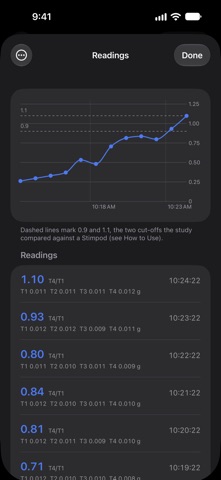
Rebuilt from the ground up, with the published measurement unchanged. • A clearer paper: T1 to T4 as bands, each peak marked and valued in g • T4/T1 to two decimals, with the two peaks it is made of • The four twitches as bars, as a percentage of T1 • Scroll back through the last ten minutes while recording continues • Save readings and chart T4/T1 across a reversal • Export readings and raw accelerometer data as CSV • How to Use: the palm strap, the method, and the study in the Canadian Journal of Anesthesia
Ratings breakdown · US
The star breakdown behind this app's rating in this storefront.
In-app purchases · US
No in-app purchases.
Screenshots


About
Put a number on the twitches your peripheral nerve stimulator produces. The app uses the iPhone's built-in three-axis accelerometer as an acceleromyograph to quantify the mechanical response to peripheral nerve stimulation. Secure the iPhone to the patient's hand, stimulate the ulnar nerve with a standard train-of-four stimulus, and the app records the resulting thumb movements. It identifies the peak of each of the four twitches and calculates the train-of-four ratio (T4/T1). REAL-TIME ACCELEROMETER VISUALIZATION The app displays the accelerometer signal in real time. Acceleration is expressed in units of gravity, where 1.0 g = 9.8 m/s². The interface simulates a scrolling paper graph, allowing the user to visualize the patient's response as it occurs. Raw accelerometer data are high-pass filtered to emphasize sudden movements while minimizing the effect of device orientation and sustained changes in position. A vertical-exaggeration slider allows users to amplify subtle movements, making small changes in twitch amplitude easier to identify. The app detects and displays the peaks corresponding to T1 through T4 and calculates the T4/T1 ratio. Users can pause and resume the recording and scroll back through previously recorded data for detailed review of the neuromuscular response. Readings can be saved, charted across a reversal, and exported with the raw accelerometer data as CSV files. HOW TO USE THE APP 1. Secure the iPhone to the patient's hand Position and secure the iPhone so that movement of the thumb is transmitted to the device. Watch: How to Secure the iPhone on the Patient's Hand https://www.youtube.com/shorts/ST0fwHNuRyk 2. Apply the train-of-four stimulus Place the stimulating electrodes over the ulnar nerve and deliver a standard train-of-four stimulus using a peripheral nerve stimulator. 3. Record and analyze the response The app captures the thumb movement produced by each stimulus, visualizes the accelerometer signal in real time, identifies the peak of each twitch, and calculates the T4/T1 ratio. Watch: How to Measure Train of Four with the iPhone App https://www.youtube.com/watch?v=L7-gLYVNhWw FROM TWITCH TO NUMBER The iPhone does not provide the electrical stimulation. Instead, it acts as the motion sensor and accelerometer, working with a standard peripheral nerve stimulator to convert the mechanical response of the thumb into a quantitative measurement. The result is a visual representation of the four twitches and a numerical T4/T1 ratio that can be reviewed in real time or after the recording. PUBLISHED Banik RK, Takeuchi K, Todd MM. A "Train of Four" iPhone application to enhance the utility of peripheral nerve stimulators. Canadian Journal of Anesthesia 2026;73:313–315. doi:10.1007/s12630-026-03108-4 IMPORTANT As the study notes, the app should not be viewed as a replacement for validated acceleromyography devices. It has not been cleared or approved by any regulator as a medical device, and clinical decisions remain with the clinician. Free. No account, no ads. No data leaves your phone unless you export it.
What's new · 2.0
Rebuilt from the ground up, with the published measurement unchanged. • A clearer paper: T1 to T4 as bands, each peak marked and valued in g • T4/T1 to two decimals, with the two peaks it is made of • The four twitches as bars, as a percentage of T1 • Scroll back through the last ten minutes while recording continues • Save readings and chart T4/T1 across a reversal • Export readings and raw accelerometer data as CSV • How to Use: the palm strap, the method, and the study in the Canadian Journal of Anesthesia
Details