

Sol Orrery
Randy Ramos · Education
Independent analytics for this App Store listing. AppTracker is not affiliated with Randy Ramos.
Chart standing · US
What changed · US
Listing changes AppTracker has observed for this app in this storefront — new versions, price moves, rating shifts, and store copy.
Updated App Store screenshots and previews. The app itself is unchanged from version 1.3.
Screenshots


About
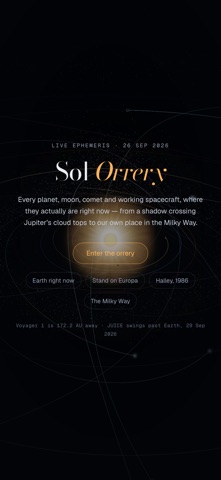
Sol Orrery is a solar system you can trust. Every position is computed from published orbital elements for the date and time you choose - not an animation loop. Watch Io's shadow cross Jupiter's cloud tops. Stand on Europa with Jupiter filling 12 degrees of sky. Follow Voyager 1 past 172 AU, or pull back until the whole Milky Way turns beneath you. WHAT YOU GET - The planets, from photographic surface maps - real continents, real cloud bands, Saturn's rings casting shadows on the planet and taking its shadow back. - 21 moons, each in its own orbit, with the tidally locked ones keeping one face turned home. - Eight comets on their true orbits - Halley, Hale-Bopp, Encke and more - growing dust and ion tails as they near the Sun. - 43 real spacecraft, each modelled and placed: Voyager 1 and 2, New Horizons, Parker Solar Probe, JUICE, Europa Clipper, Juno, Perseverance, the ISS and Tiangong. - Around 9,000 satellites in Earth orbit - Starlink's real shells, GPS, Galileo, the geostationary belt - dimming as they pass into Earth's shadow. - Eclipses that are actually computed: the Moon turning copper in Earth's umbra, a moon's shadow tracking across a planet's face. - Stand on a world: Tranquility Base, Jezero crater, the ice of Europa, the south pole of Enceladus. Angular sizes are true - the Sun really is three times wider from Mercury. - Time from real-time to 100 million years per second, forwards or backwards, across a billion years. - True scale mode: swap the readable layout for real sizes at real distances. - Zoom out past the heliopause, through the Oort cloud and the nearest stars, to the Galaxy - with our own position marked. HONEST ABOUT ITS LIMITS Planet positions use JPL's approximate elements (accurate within about 1800-2050); the lunar theory is good to roughly a tenth of a degree, so eclipse times are approximate to a few minutes. Spacecraft cruise paths between real flyby dates are interpolated. The app says so, on the panel for each object, rather than pretending otherwise. No account, no ads, no tracking, no network. Everything runs on your device, offline. Planetary and lunar surface maps by Solar System Scope (solarsystemscope.com), used under CC BY 4.0.
What's new · 1.3.1
Updated App Store screenshots and previews. The app itself is unchanged from version 1.3.
Details