

Daltona Color Blind Simulator
Yaniv van der Stigchel · Developer Tools
Independent analytics for this App Store listing. AppTracker is not affiliated with Yaniv van der Stigchel.
Chart standing · US
In-app purchases · US
No in-app purchases.
Screenshots


About
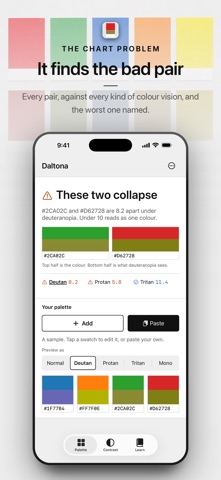
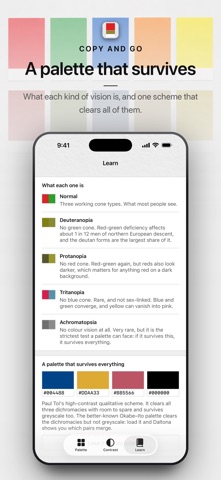
The red and the green in the default chart palette are obvious to most people and the same colour to a deuteranope. Daltona finds that pair before your users do. Put your palette in. Daltona checks every pair against every kind of colour blindness, and tells you which two collapse — not "here is a simulation, you decide", but the worst pair, named, with the numbers. WHAT IT ACTUALLY CHECKS Every colour, under deuteranopia, protanopia, tritanopia and full monochromacy. Each swatch shows the colour you chose on top and what that vision sees underneath, touching, with no line between them — because the question is whether they are the same colour, and a border would let your eye pretend they are not. Tap any swatch to see it under all five at once. TWO DIFFERENT TESTS, AND THEY DISAGREE WCAG contrast ratios, with all four conformance levels and real text at real sizes on the real background — because a number alone tells you nothing until you see it. And then the point: contrast is a luminance relationship, so it barely moves under colour blindness. Two colours can pass AAA and still collapse into each other; two others can fail everything and stay perfectly distinct. Passing contrast is not being distinguishable. Daltona does both and shows them side by side. IT ALSO CHECKS THE GREYSCALE A palette can be perfectly colour-blind-safe and still be told apart by hue alone — which does not survive a photocopier, a bad projector or a black-and-white print. Daltona reports that separately, as a note rather than a failure, because it is a different question. A PALETTE THAT SURVIVES There is one built in that clears all three dichromacies and greyscale as well, ready to copy. It is not the famous one. Okabe–Ito clears colour blindness, but seven of its pairs merge in greyscale, and Daltona shows you which. WHAT IT IS NOT It simulates the three dichromacies, the complete absence of one cone type, using the published methods of Viénot, Brettel and Mollon: the 1999 method for protanopia and deuteranopia, and the 1997 two-plane method for tritanopia. The far more common anomalous forms vary continuously in severity and cannot be shown by any fixed transform, so Daltona does not pretend to. This approximates what a PALETTE does, not what a PERSON sees. Colour vision is individual and no simulation replaces asking someone. It is not a test and it diagnoses nothing. If you want to know about your own colour vision, an optometrist is the answer, not an app. No camera, no photo access, no permissions of any kind. Nothing leaves the phone. Free, with no in-app purchase and no ads.
Details