

Onomatope: Japanese Mimetics
Jakub Dwojak · Education
Independent analytics for this App Store listing. AppTracker is not affiliated with Jakub Dwojak.
Chart standing · US
What changed · US
Listing changes AppTracker has observed for this app in this storefront — new versions, price moves, rating shifts, and store copy.
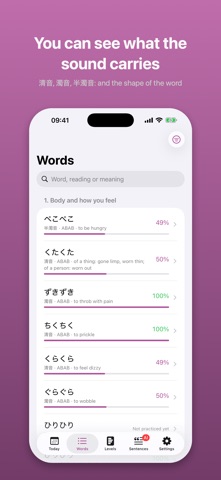
The word card has a new layout. When to use it, what the sound carries, examples with the clue that points to the word, and similar words with one line on the difference. Compare similar words side by side. Open a similar word on the card to see both in sentences. After a mix-up between similar words, the check screen tells you how they differ. 14 new words. Words with two meanings, like むかむか (queasy and angry) or ごろごろ (rolling and lazing about), now have separate entries. “What does it mean?” no longer puts near-synonyms side by side. The review button says how many questions the session will ask. Questions that come back after a mistake are shown separately on the progress bar. “Continue” always sits at the bottom of the screen. Answers use a smaller font.
In-app purchases · US
What this app sells inside itself, grouped by kind and priced for this storefront.
Screenshots





About
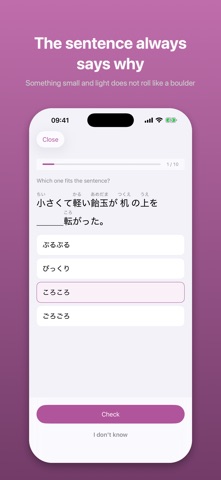
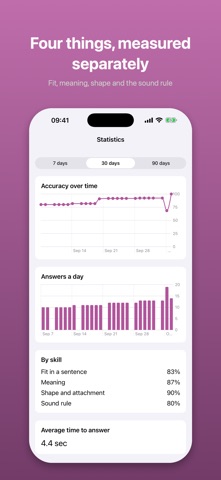
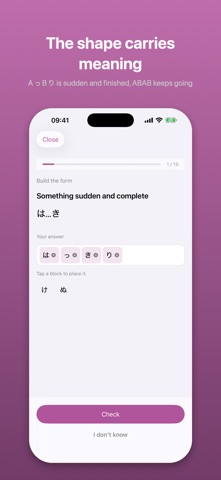
Three hundred onomatopoeia are not a list to memorize. They are a system where the sound carries the meaning – and that is what this app teaches. Something small and light rolls ころころ. Something big and heavy rolls ごろごろ. The difference is two dots, not two separate words. さらさら is smooth, ざらざら is rough. ぱらぱら is light, ばらばら is scattered. Understand what 濁点 does and you can guess a word you have never met – no dictionary gives you that. FOUR THINGS, MEASURED SEPARATELY Fit in a sentence. Which of four similar sounds this sentence asks for. The sentence always says why – something small and light does not roll the way a boulder does. Meaning. What the word says on its own. Always from the sound to the meaning, never the other way round: without a sentence, four similar sounds have no single answer. Shape and attachment. AっBり is sudden and finished, ABAB keeps going. And how the word enters the sentence: 〜と, 〜する, 〜だ・の. Sound rule. What 濁点 does to a word. Measured only on material that is not on the review schedule, so it tells you whether you can guess a word you have never seen. THE PAIR, NOT THE AVERAGE The app does not say "ごろごろ 44%". It says: you put ごろごろ where ころころ belongs – but not the other way round. With these words the direction of the mistake is the whole information, and an average hides it. SIX LEVELS, NOT JLPT Body and how you feel. Voicing: the pairs. Feelings and people. The 〜っ〜り shapes. The world: weather, food, textures. Attachment and sounds. A rule and a theme in turn – every batch of words is followed by a level teaching the rule that governs them all. You hear ぺこぺこ on your first day in Japan and it is on no N5 list – so the levels are practical, not exam-shaped. The first two are free in full. WHAT COMES BACK, AND WHAT DOES NOT Words come back on a schedule, because they are facts and facts fade: nothing in the sound of ぐっすり tells you it is about sleep rather than mud. Rules do not come back that way – 濁点 works whether you were reminded of it or not. A rule is not forgotten, it is left unused, and that shows up in your mistakes rather than on a calendar. SENTENCES, WITH AI The Sentences tab takes a line from a manga, an anime or subtitles – typed or scanned from a photo – and tells you which onomatopoeia it has and what they mean right there. It works the other way too: describe a sound or a feeling and get the word that fits best, plus a few others with how they differ. Words from this app open their page, and you can add the line to a word as an example. Some requests each month are free; more come with a subscription: PLN 9.99 monthly or PLN 79.99 yearly, auto-renewing, cancellable in your Apple ID settings. Levels and exercises do not depend on it. WHAT IS NOT HERE No keyboard input in the exercises: we measure the choice between four sounds, not your thumb. No question about whether a word is written ドキドキ or どきどき – manga writes everything in katakana, so that question has two right answers. No accounts, no ads. Learning works offline; only the Sentences tab talks to our server, sending just the text. ONE PURCHASE Levels 1 and 2 are free in full – not out of generosity but because a free version should be shorter, not pretend. The other levels are a single purchase, with nothing to renew. TERMS Terms of Use (EULA): https://www.apple.com/legal/internet-services/itunes/dev/stdeula/ Privacy Policy: https://jd-japanese.pl/onomatope/1.6/en/privacy.html
What's new · 1.7.0
The word card has a new layout. When to use it, what the sound carries, examples with the clue that points to the word, and similar words with one line on the difference. Compare similar words side by side. Open a similar word on the card to see both in sentences. After a mix-up between similar words, the check screen tells you how they differ. 14 new words. Words with two meanings, like むかむか (queasy and angry) or ごろごろ (rolling and lazing about), now have separate entries. “What does it mean?” no longer puts near-synonyms side by side. The review button says how many questions the session will ask. Questions that come back after a mistake are shown separately on the progress bar. “Continue” always sits at the bottom of the screen. Answers use a smaller font.
Details