

NCLS モニター Pro
Code Blue Co.,Ltd. · Medical
Independent analytics for this App Store listing. AppTracker is not affiliated with Code Blue Co.,Ltd.
Chart standing · US
What changed · US
Listing changes AppTracker has observed for this app in this storefront — new versions, price moves, rating shifts, and store copy.
- Vital signs now start changing as soon as you press Next - ECGs match each case: ST elevation in myocardial infarction, U waves in hypokalaemia and QT prolongation, and ectopics or bigeminy where the chart records them - The rhythm chosen by Arrest now follows the pathophysiology: PEA for haemorrhage, hypoxia, pneumothorax and tamponade; VF for myocardial infarction and hypokalaemia; asystole for AV block
In-app purchases · US
No in-app purchases.
Screenshots


Similar apps
Competitors and close alternatives, as estimated by AppTracker.
 Simpl Patient Monitor
Michael George
Simpl Patient Monitor
Michael George
 Medical Rescue Sim Pro
Toni Schwaiger
Medical Rescue Sim Pro
Toni Schwaiger
 CCF Monitor – CPR Timer
AMR TEAM TOKAI, LIMITED LIABILITY COMPANY
CCF Monitor – CPR Timer
AMR TEAM TOKAI, LIMITED LIABILITY COMPANY
 ECG Pro | Road to Mastery
WMS, Inc
ECG Pro | Road to Mastery
WMS, Inc
 ECG and ACLS Tutor
Anesoft Corporation
ECG and ACLS Tutor
Anesoft Corporation
 Code Ready Pro - Pediatric
Blackfox Media LLC
Code Ready Pro - Pediatric
Blackfox Media LLC
 Code Runner Pro: CPR Timer
Angel Vazquez
Code Runner Pro: CPR Timer
Angel Vazquez
 ECG Books
WMS, Inc
ECG Books
WMS, Inc
About
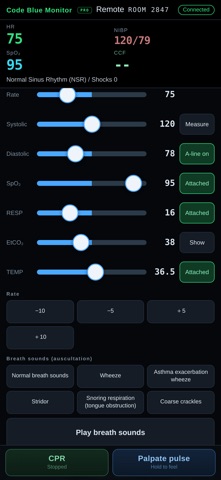
The full-feature edition for training. No in-app purchases — every feature is available from the start. Built for emergency response training for nurses, ACLS and ALS courses, and simulation education. Use an iPad as the patient monitor and an iPhone as the instructor's remote. The two devices connect directly — no Wi-Fi network or cables needed. The remote iPhone runs on the free Code Blue Monitor app. 52 CHART CASES — ADVANCE THEM STEP BY STEP - 52 ward patients, each with physician and nursing notes, labs, imaging and orders, presented like a real chart - Filter by the learners' unit: surgical, medical, neurosurgical, cardiology, obstetrics, dialysis and more - Each case starts at a stable point; every press of Next changes the ECG and vitals to follow the chart - ECGs match the pathophysiology: ST elevation in myocardial infarction, U waves in hypokalaemia, and more - Blood gas, imaging, breath sounds and pupils show what fits that point in time - Press Arrest to move into cardiac arrest at any point (PEA for haemorrhage or hypoxia, VF for myocardial infarction, and so on), or Improve to steer towards recovery — the outcome follows what the learners do - For every case: an instructor overview (how the case unfolds, with vital-sign changes) and a debriefing guide (pathophysiology, expected actions, SBAR example, discussion questions) PATIENT MONITOR - 35 ECG rhythms: sinus rhythm, sinus bradycardia and tachycardia, atrial fibrillation and flutter, SVT, ectopics, VT (with and without a pulse), VF, asystole, PEA, first- to third-degree AV block, ST elevation and depression, hyperkalaemia, WPW, paced rhythm and more - Heart rate, NIBP, arterial line, SpO₂, respiratory rate, EtCO₂ and temperature - Four waveforms: ECG, pleth, arterial pressure and capnography - Values appear only when a sensor is attached; any value can be hidden - Freely adjustable alarm limits that switch automatically with the patient's age - QRS beep, NIBP cuff sounds and a CPR metronome DEFIBRILLATOR AND AED - 2–270 J dial laid out like a real device: off, monitor, AED, internal discharge, energy and pacing - Charge, shock, synchronised shock and internal discharge - Voice-guided AED mode: pads, analysis, charging, shock and CPR prompts in English, Japanese and Spanish - Transcutaneous pacing: demand or fixed, rate and output (mA); the capture threshold can also be set from the remote - Charge and shock sounds recorded from real devices - Chest compression fraction (CCF) measurement INVESTIGATIONS AND FINDINGS - 47 blood gas cases. Asthma, sepsis,
What's new · 2.3
- Vital signs now start changing as soon as you press Next - ECGs match each case: ST elevation in myocardial infarction, U waves in hypokalaemia and QT prolongation, and ectopics or bigeminy where the chart records them - The rhythm chosen by Arrest now follows the pathophysiology: PEA for haemorrhage, hypoxia, pneumothorax and tamponade; VF for myocardial infarction and hypokalaemia; asystole for AV block
Details