

StationDeck
TIMOTHY JOHN FANEUF · Weather
Independent analytics for this App Store listing. AppTracker is not affiliated with TIMOTHY JOHN FANEUF.
Chart standing · US
What changed · US
Listing changes AppTracker has observed for this app in this storefront — new versions, price moves, rating shifts, and store copy.
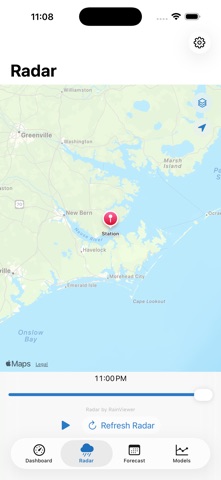
A SHARPER RADAR The radar now uses the national NEXRAD mosaic, which resolves individual storm cells at about 500 metres. The previous source stopped adding detail past county level, so zooming in magnified the picture rather than sharpening it. Storms that used to blur into one blob are separate cells now. FUTURE RADAR The radar timeline now carries on past the present. Drag it forward and the map keeps going for three hours, with every frame past now marked Forecast. The next hour is the radar itself, carried forward along the way the rain is actually moving, in five-minute steps. It is measured from the last two scans rather than modelled, so it is only minutes behind — but it only knows about rain that already exists, and it cannot tell that a storm is about to fade or build. After that it hands over to NOAA's forecast model, in fifteen-minute steps. The model does know that storms grow and die, but its run is a couple of hours old by the time anyone sees it. It puts storms roughly where and roughly when; a cell on screen is not a prediction of that cell. Neither is a scan of something that has happened. Turn the whole thing off under Radar Options. WILL IT RAIN, AND WHEN The forecast now opens with the answer instead of making you look for it: when rain next arrives, the chance at that hour, and how much is expected over the next day. The amount is new — the Weather Service publishes it, and the app had never asked for it. Light drizzle on the horizon does not count; it takes a real chance of real rain to say rain is coming. THE RADAR KEEPS ITSELF CURRENT The radar refreshes itself while you are watching it and again when you come back to the app, instead of showing whatever it loaded when you first opened the tab. A storm can no longer cross the county while the map sits still. THE TIME UNDER THE MAP IS THE RADAR'S The clock under the radar now reports when the scan was made, not when you are looking at it. Where a source will not say, the time is rounded down to the interval it is built on, so the radar never claims to be more current than it is. FEWER FALSE ALARMS On clear nights, radar picks up birds, insects and returns bent back to the ground by the air itself, and twice these were reported as rain on the way. Storm alerts now check NOAA's precipitation-type analysis before they fire, so an echo the Weather Service does not confirm as precipitation stays quiet. WHICH BUILD AM I ON Settings now ends with the version, the build number, and how this copy was installed. Worth quoting if you ever write in about a problem.
In-app purchases · US
No in-app purchases.
Screenshots


About
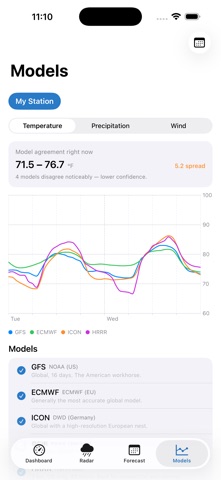
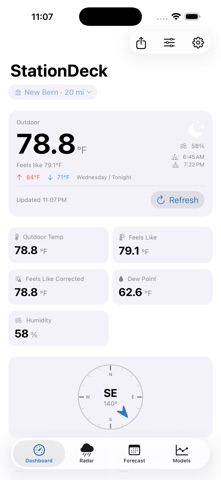
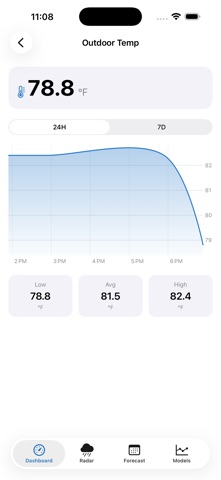
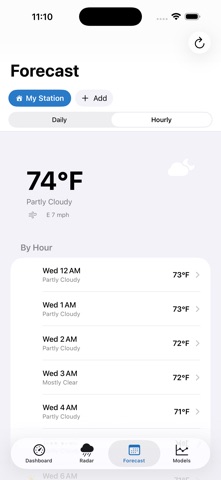
StationDeck turns a personal weather station into the weather app you actually want — and works even before you own one. Connect an Ecowitt or Ambient Weather station, or pull readings through Home Assistant. Point it at any public Weather Underground station — usually a neighbour's back garden rather than an airport twenty miles away. Don't have a station yet? Start with the nearest official National Weather Service station and add your own hardware later. YOUR DASHBOARD, YOUR ORDER Every card can be reordered or hidden. Temperature, feels-like, dew point, humidity, wind, rain, pressure, solar, UV, indoor conditions — arranged the way you read them, not the way someone else decided. FEELS LIKE, CORRECTED The standard heat index is a shade figure. The National Weather Service notes that direct sun can add as much as 15°F to how hot it actually feels. StationDeck uses your station's own solar sensor to apply that correction, alongside NWS wind chill when it's cold — a number your station's stock feels-like doesn't give you. TRENDS THAT GO SOMEWHERE Tap any reading for its history: 24 hours, 7 days, 30 days or a full year, with high, low and average. Barometric tendency is read out properly — rising, falling, and what that usually means — because a bare pressure number tells you nothing on its own. WIND, READ CORRECTLY Direction on a compass dial rather than a bare number, and a wind rose showing where the wind actually came from over time. Not a line chart, which is meaningless for a value that wraps through north. RADAR AND FORECASTS Animated precipitation radar with adjustable base map, opacity and playback. Official NWS forecasts, daily and hourly, for your station and any other town you care about. Severe weather alerts scoped to your exact coordinates. WEATHER MODELS Compare GFS, ECMWF, ICON, HRRR and five more side by side, as charts or as a map you can scrub through hour by hour. When the models disagree, that spread is the honest measure of confidence — and StationDeck shows it rather than hiding it behind a single number. ALL-TIME RECORDS Hottest, coldest, strongest gust, wettest day and wettest month, each with the date it happened, computed from your station's own history. SENSOR HEALTH Battery voltages become plain language — Good, Fair, Replace Soon — with an estimate of how long is left, learned from the actual drain rate over time. Solar-charged sensors are treated as what they are rather than flagged as failing every night. WIDGETS AND LIVE ACTIVITIES Home Screen widgets with four independently chosen readings, Lock Screen widgets, and a Live Activity that starts on its own when it rains or the wind gets up. ALERTS THAT MATTER High gust, freezing, heavy rain, low sensor battery, and a station that has stopped reporting — plus official NWS severe weather warnings. BUILT THE WAY IT SHOULD BE No account. No analytics. No tracking. No advertising. StationDeck never asks for your location — you tell it where you are. Your API keys stay in the device Keychain and are sent only to the service they belong to. Settings sync through your own iCloud account, which the developer cannot see. Forecasts, alerts and official station observations cover the United States and its territories. Your own station, radar and weather models work anywhere.
What's new · 1.0.5
A SHARPER RADAR The radar now uses the national NEXRAD mosaic, which resolves individual storm cells at about 500 metres. The previous source stopped adding detail past county level, so zooming in magnified the picture rather than sharpening it. Storms that used to blur into one blob are separate cells now. FUTURE RADAR The radar timeline now carries on past the present. Drag it forward and the map keeps going for three hours, with every frame past now marked Forecast. The next hour is the radar itself, carried forward along the way the rain is actually moving, in five-minute steps. It is measured from the last two scans rather than modelled, so it is only minutes behind — but it only knows about rain that already exists, and it cannot tell that a storm is about to fade or build. After that it hands over to NOAA's forecast model, in fifteen-minute steps. The model does know that storms grow and die, but its run is a couple of hours old by the time anyone sees it. It puts storms roughly where and roughly when; a cell on screen is not a prediction of that cell. Neither is a scan of something that has happened. Turn the whole thing off under Radar Options. WILL IT RAIN, AND WHEN The forecast now opens with the answer instead of making you look for it: when rain next arrives, the chance at that hour, and how much is expected over the next day. The amount is new — the Weather Service publishes it, and the app had never asked for it. Light drizzle on the horizon does not count; it takes a real chance of real rain to say rain is coming. THE RADAR KEEPS ITSELF CURRENT The radar refreshes itself while you are watching it and again when you come back to the app, instead of showing whatever it loaded when you first opened the tab. A storm can no longer cross the county while the map sits still. THE TIME UNDER THE MAP IS THE RADAR'S The clock under the radar now reports when the scan was made, not when you are looking at it. Where a source will not say, the time is rounded down to the interval it is built on, so the radar never claims to be more current than it is. FEWER FALSE ALARMS On clear nights, radar picks up birds, insects and returns bent back to the ground by the air itself, and twice these were reported as rain on the way. Storm alerts now check NOAA's precipitation-type analysis before they fire, so an echo the Weather Service does not confirm as precipitation stays quiet. WHICH BUILD AM I ON Settings now ends with the version, the build number, and how this copy was installed. Worth quoting if you ever write in about a problem.
Details