

Keigo: Polite Japanese
Jakub Dwojak · Education
Independent analytics for this App Store listing. AppTracker is not affiliated with Jakub Dwojak.
Chart standing · US
What changed · US
Listing changes AppTracker has observed for this app in this storefront — new versions, price moves, rating shifts, and store copy.
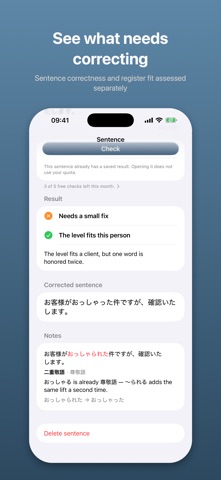
A Home Screen widget shows today’s reviews. Small and large widgets and Lock Screen widgets show the exact number of questions waiting, and can include progress in the other family apps. The review schedule covers the next 48 hours and 7 study days. It opens the exact review dates and times, counted from the same plan as the Today screen. You can add your own mnemonic to any expression. It is saved only on this device and included in your progress backup. You choose which family apps are shown. App recommendations and Your Japanese have separate switches, and a legend explains the markers. Upcoming apps have their own cards, and Shindan shows your level from N5 to N1 instead of a percentage. AI check results appear without scrolling. A correction identical to your sentence is no longer shown a second time. Situations and explanations have been fully reviewed. Prompts say what the speaker wants, explanations no longer teach rules without exceptions, and invalid forms have their own label.
In-app purchases · US
What this app sells inside itself, grouped by kind and priced for this storefront.
Screenshots




About
The Japanese honorific register is not a list of forms to memorise. It is a decision about who you are talking to. You can know that 伺う is the humble form of 行く and still aim it at a classmate one year above you. You can know お〜になる and use it about your own boss in front of a customer. The difference is not in the form – it is in who is speaking to whom. That is what Keigo asks about. FOUR SKILLS MEASURED APART Register – who this form is right for. Direction – whose action it is: yours or theirs. Production – building the form from its parts. Overdone keigo – recognizing that the politeness is one step too much. You can pick the humble register flawlessly and consistently humble the wrong person. An app that averages those four numbers into one has no way to show you that. This one shows it. TOO MUCH KEIGO IS A MISTAKE TOO 二重敬語 and バイト敬語 – forms that sound polite and are wrong. They are heard every day and almost nobody corrects them. Here they are a question type of their own and a skill measured on its own. FIVE LEVELS, NOT FIVE LISTS 1. Swapping the word itself – です/ます and the twenty forms no rule will produce. 2. Building keigo by rule, not from a list – お〜になる, お〜する, 美化語. 3. Saying who does whom a favour – 〜ていただく, 〜てくださる and the whole difference between them. 4. Hearing when keigo rings wrong – 二重敬語 and バイト敬語. 5. Hitting the register in a real situation – the same boss takes an honorific in front of a colleague and does not take one in front of a client. IT KNOWS WHICH WAY ROUND YOU CONFUSE THEM A mistake has a direction. Using 伺う where いらっしゃる belongs is a different fault than the reverse, because the first lowers the other person and the second raises you. The app measures the two apart and says which way round you swap them. YOU ANSWER WITH TILES, NOT A KEYBOARD Forms are built from parts. There is no text field, so a typo can never be mistaken for not knowing, and you do not need a Japanese keyboard at all. REVIEW THAT KEEPS ITS OWN SCHEDULE Vocabulary comes back on a ladder of intervals, from a few hours to half a year. Patterns and rules have no due dates, and that is a decision rather than a gap: お〜になる should come out without thinking, and 内/外 is a judgment, not a fact that fades. You see one Today screen, one daily goal and one number; the difference sits in which questions come up. CHECK YOUR OWN SENTENCE The Check tab keeps a list of your sentences – typed or scanned from a photo. You pick who you are speaking to, and AI judges the Japanese and the level separately and marks the mistake in your sentence. A few checks a month are free; more come with a subscription: PLN 9.99 monthly or PLN 79.99 yearly, auto-renewing, cancellable in your Apple ID settings. Levels and exercises do not depend on it. NO ACCOUNT, NO ADS The material ships inside the app and learning works offline. Your progress and your list of sentences stay on the device; only Check talks to our server, sending just the sentence and who it is for. No sign-in, no tracking, no advertising. WHAT IS FREE Levels 1 and 2 in full – です/ます, the twenty irregular forms and the productive patterns: thirty-one entries out of seventy. A single purchase opens levels 3 to 5: favours and direction, overdone keigo and all twenty-seven situations. The material has no subscription. THE REST OF THE FAMILY Keigo is the seventh app in the same family. Kaname teaches grammar, Katsuyokei conjugation, Joshi particles, Kazoekata counters, Bunmyaku reading in context, Kuzushi casual speech. Each one shows your progress in the others – with no account and without sending anything anywhere. THE ARBITER The category split and every contested call follow 文化庁「敬語の指針」(2007). Where business etiquette guides disagree with each other, the app says whose side it takes. TERMS Terms of Use (EULA): https://www.apple.com/legal/internet-services/itunes/dev/stdeula/ Privacy Policy: https://jd-japanese.pl/keigo/1.5/en/privacy.html
What's new · 1.6.0
A Home Screen widget shows today’s reviews. Small and large widgets and Lock Screen widgets show the exact number of questions waiting, and can include progress in the other family apps. The review schedule covers the next 48 hours and 7 study days. It opens the exact review dates and times, counted from the same plan as the Today screen. You can add your own mnemonic to any expression. It is saved only on this device and included in your progress backup. You choose which family apps are shown. App recommendations and Your Japanese have separate switches, and a legend explains the markers. Upcoming apps have their own cards, and Shindan shows your level from N5 to N1 instead of a percentage. AI check results appear without scrolling. A correction identical to your sentence is no longer shown a second time. Situations and explanations have been fully reviewed. Prompts say what the speaker wants, explanations no longer teach rules without exceptions, and invalid forms have their own label.
Details