

LinguaKata: Pronunciation
Spaikz LLC · Education
Independent analytics for this App Store listing. AppTracker is not affiliated with Spaikz LLC.
Chart standing · US
Screenshots


About
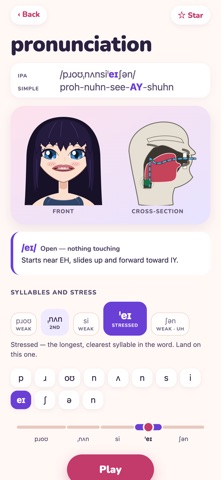
See a word pronounced. Type any word. An avatar's mouth, lips and tongue move through it slowly enough to copy — and a cross-section of the head shows the part you can never see in a mirror: where the tongue actually goes. WHY A CROSS-SECTION /p/ and /m/ look identical from the front. The lips do exactly the same thing. The only difference is the soft palate, which sends the air out through the nose instead — so the app draws the air as well as the mouth. "Thin" and "sin" differ by where the tongue tip sits. If you cannot see it, you cannot copy it. WHAT IT SHOWS - All 39 sounds of English, with the jaw, lips, tongue, soft palate and voicing each modelled separately - A front view and a mid-sagittal cross-section, both drawn from the same underlying position - Airflow, drawn as it happens: through the mouth, out of the nose for a nasal, or trapped behind a closure - Aspiration where English actually has it — "pin" puffs, "spin" does not - Syllables and stress, with the stressed syllable drawn larger and the weak ones smaller - Vowel reduction, so an unstressed vowel looks as vague as it sounds - Three notation systems side by side — IPA, dictionary respelling and plain letters — each highlighting the sound being spoken HOW YOU USE IT Choose a speed from 0.25x to 1x. Tap any sound to freeze it and study the shape. Drag through a word syllable by syllable, forwards or back. Pick from seven avatars: four anime-style people and three characters. The mouth is identical on every one of them, because the mouth is the thing you came for. Three themes, and every colour checked for contrast rather than eyeballed. WORKS OFFLINE 126,036 words are built in. No account, no network, no ads and nothing to subscribe to. A word outside the dictionary is worked out from its spelling and labelled clearly as an estimate — because a guess presented as a fact would be worse than no answer at all. HONEST ABOUT WHAT IT IS NOT The shapes are accurate. The timing of each individual sound is modelled rather than measured, so a sound can fall a little early or late inside a word, and the app tells you so on screen instead of pretending otherwise. At slower speeds the voice cannot stretch as far as the animation does, because phones do not slow speech as far as they are asked to. So the voice says the real word and finishes first, and the mouth carries on through the rest of it — every sound you hear is right, and the screen says so. It shows; it does not listen. There is no recording and no scoring. For anyone learning English pronunciation, for teachers who need to point at what the tongue is doing, and for speech and language work where seeing the articulation is the point.
Details