

Katsuyokei — Conjugation
Jakub Dwojak · Education
Independent analytics for this App Store listing. AppTracker is not affiliated with Jakub Dwojak.
Chart standing · US
What changed · US
Listing changes AppTracker has observed for this app in this storefront — new versions, price moves, rating shifts, and store copy.
Plain forms that have a polite counterpart now say “plain” in their name, such as plain past negative. If you answer with the polite form instead of the plain one, or the other way round, the check says so: the conjugation is right, only the level of politeness is not. “I don't know” asks before it counts. A stray tap no longer closes the question: you first see that it will count as a miss, and you can go back. The reminder mentions your streak. When you have practiced at least two days in a row and today has no session yet, it adds, for example, “5 days in a row – keep it going”. Reminders for later days leave the streak out, since nobody knows yet whether it will last. In “Your weakest”, a form practiced fewer than eight times shows how many answers are behind it, such as “3 of 8 answers”. The bar grows with the number of answers, so a shorter bar further down the list means fewer answers so far, not a weaker form.
Price & rating history · US
Reconstructed from the listing changes AppTracker has observed in this storefront. A field is charted once it has changed more than once, and each line starts at the value it moved from.
Average rating · ★ 0.00 now · 2 changes on record
Screenshots




About
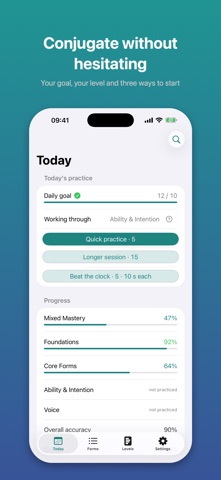
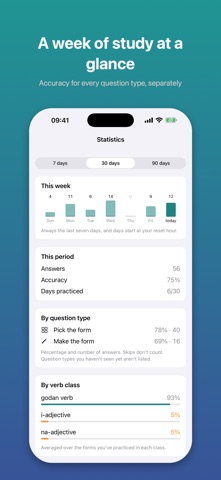
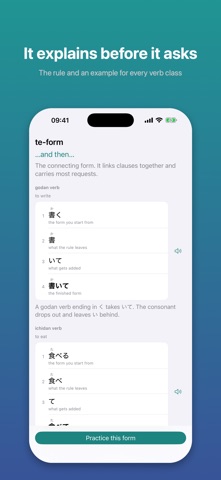
Japanese conjugation is not a table to memorise. Either the form comes out without thinking, or it does not come out at all. Knowing that the te-form exists is not the same as producing 書いて without stopping to think. The first is understanding; the second is a reflex, and a reflex is built by repetition and feedback, not by explanation. WHAT YOU PRACTICE Verb classes – godan, ichidan, and the irregulars. Including the verbs that look like one class and behave like another: 帰る, 入る, 走る and 切る end in -る and are godan, and that is exactly where most mistakes live. Every form you actually need: polite ます forms, the plain negative, the plain past, the te-form and its sound changes, conditionals, potential, volitional, imperative, prohibitive, passive, causative, and the causative-passive along with its spoken contraction. Adjectives too – both kinds, including いい, which stops behaving like an adjective the moment you negate it. FIVE WAYS TO BE ASKED Pick the right form from four options. Type the form yourself. Name a form you are shown. Name the conjugation class. Take a conjugated word back to its dictionary form. The app moves you along that ladder on its own: a form you have just met starts with multiple choice, because typing something you have never seen is guessing, not practice. WHEN YOU GET IT WRONG You see the transformation, not a red cross. 書く → 書か + ない → 書かない, with one line explaining the rule underneath. No paragraphs in the middle of a session. WRONG ANSWERS THAT TEACH The distractors are the mistakes learners actually make. Practice the te-form of 帰る and you will be offered 帰て – the answer you would give if you thought it were an ichidan verb. MASTERY YOU CAN TRUST Three lucky answers do not show mastery, and five hundred wrong ones do not either. Progress is measured per form and per verb class separately, because the te-form of an ichidan verb and the te-form of a godan verb ending in ぐ are not the same skill. Sessions lean towards whatever you keep getting wrong. SESSIONS THAT FIT Five questions by default, fifteen in a longer session. A minute or seven, one tap from opening the app. No setup, no daily quota to configure, no streak to protect at midnight – the streak survives a missed evening and breaks after a missed day. ENGLISH AND POLISH Interface and content switch independently, so a Polish menu with English grammar terms is a normal combination rather than a compromise. PRIVATE BY CONSTRUCTION Everything stays on your device. No account, no sign-in, no analytics, no advertising, no tracking. The app makes no network requests at all apart from handling the purchase itself. It works in aeroplane mode. FREE AND PREMIUM Levels 1 and 2 are free in full – enough to reach the te-form, which is the point at which Japanese starts connecting into sentences. Premium is a single purchase that opens levels 3 to 5, the full vocabulary pool and weak-form practice. No subscription. Also from the same author: Kaname – Japanese Grammar, for when and why a construction is used, rather than how to build it.
What's new · 1.4.1
Plain forms that have a polite counterpart now say “plain” in their name, such as plain past negative. If you answer with the polite form instead of the plain one, or the other way round, the check says so: the conjugation is right, only the level of politeness is not. “I don't know” asks before it counts. A stray tap no longer closes the question: you first see that it will count as a miss, and you can go back. The reminder mentions your streak. When you have practiced at least two days in a row and today has no session yet, it adds, for example, “5 days in a row – keep it going”. Reminders for later days leave the streak out, since nobody knows yet whether it will last. In “Your weakest”, a form practiced fewer than eight times shows how many answers are behind it, such as “3 of 8 answers”. The bar grows with the number of answers, so a shorter bar further down the list means fewer answers so far, not a weaker form.
Details