

QRTL Earth Magnetopause
David Nishimoto · Education
Independent analytics for this App Store listing. AppTracker is not affiliated with David Nishimoto.
Chart standing · US
In-app purchases · US
No in-app purchases.
Screenshots

About
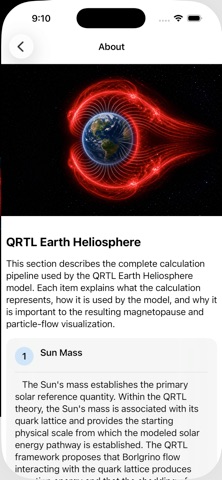
The QRTL Earth Heliosphere model describes a connected calculation pathway in which the Sun and Earth establish the initial reference quantities, while solar-wind conditions and Earth’s magnetic field determine the modeled magnetopause response. Within the QRTL theory, mass is associated with a quark lattice, and Borlgrino flow interacting with that lattice is proposed to produce vibration energy. When excess energy is shed from the lattice, the released energy is represented as modeled electrical current. The Sun provides the upstream solar reference, while Earth provides a corresponding terrestrial reference. The solar energy pathway is treated like a pumping and circulation system: the Sun acts like an upstream pump, modeled solar power represents the supplied energy, the Birkeland current represents electromagnetic flow, Earth’s magnetic field provides the routing structure, and coherence represents how effectively the flow remains organized. Only a portion of the modeled energy is transferred through the pathway, similar to a pump system in which valves, friction, and side branches prevent all supplied energy from reaching one destination. The modeled current and lattice voltage establish electrical power, while transport efficiency and QRTL coherence determine how much energy remains available for downstream use. Available and delivered power describe the portion of modeled energy that successfully passes through the electrical pathway. Separately, the solar wind provides an external pressure source. Solar-wind density and velocity determine dynamic pressure, which acts against Earth’s magnetic environment. A useful analogy is an umbrella in a strong stream of water: the solar wind is the incoming water, Earth’s magnetic field is the umbrella, and the magnetopause is the moving edge where the opposing forces balance. A stronger magnetic field provides greater resistance to the incoming flow, while stronger solar-wind pressure compresses the boundary toward Earth. Earth’s magnetic field decreases with distance according to the modeled dipole relationship. The calculated magnetopause distance therefore determines the magnetic-field strength at the boundary. That field is converted into magnetic pressure, and magnetic pressure acting across the effective boundary area produces the modeled macroscopic magnetopause magnetic force. This force is then converted into a normalized deflection strength. The deflection strength determines how much of the incoming solar-wind direction remains and how strongly the flow is redirected tangentially around Earth. The local Earth surface normal establishes the outward direction, the solar-wind projection identifies the radial component, and the remaining component provides the tangential flow direction. These directional components are combined and normalized to produce the final particle-flow direction. The magnetopause emitters visualize this calculated response. Each emitter is positioned using latitude and longitude, oriented according to the final flow direction, and given a baseline particle velocity with additional force-dependent and natural variation. The resulting particles visually represent the modeled interaction between incoming solar-wind flow and Earth’s magnetic boundary. The electrical QRTL pathway and solar-wind magnetic pathway are conceptually connected within the overall framework, but in the current implementation they remain separate calculation branches: QRTL energy primarily represents the modeled electrical state, while solar-wind pressure and magnetic-field calculations directly determine the magnetopause position, magnetic force, deflection, and particle flow.
Details