

Roots Companion 尋根
Yiwen Luo · Reference
Independent analytics for this App Store listing. AppTracker is not affiliated with Yiwen Luo.
Chart standing · US
In-app purchases · US
No in-app purchases.
Screenshots


About
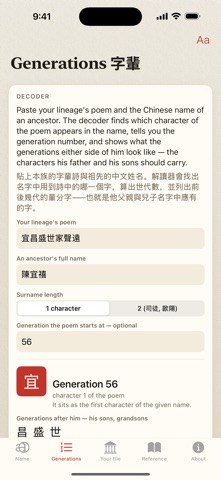
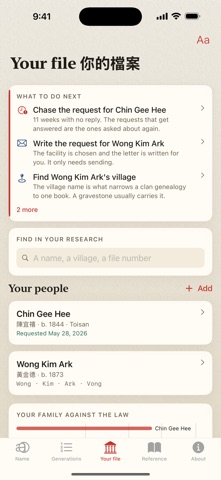
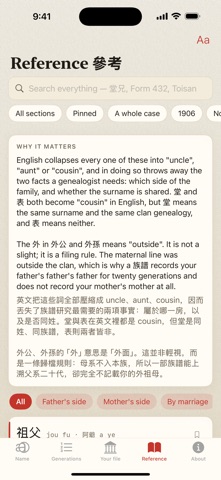
A photocopied file arrives from the National Archives. The applicant is "Lee Tah Fu". A related paper says "S.N.D." The village is on no map you can find. You read English and some Mandarin, and none of it connects. It does not connect because the name was written down by an English-speaking clerk listening to a dialect he did not speak, using no standard at all. It was usually Toisanese, which no romanization system was ever built for — so Pinyin will never find it. WORK OUT HOW THE NAME WAS SPELLED Type Chinese characters and see the spellings a clerk might have written; type a spelling from a record and see which characters it could be. 陳 is Chan in a Hong Kong family and Chin in a Toisan one. 譚 became Hom. 司徒 became Soo Hoo. These are sound rules, not errors, and the app runs them both ways — with spellings found in real records kept separate from the ones it derived. Hear the two read aloud, which is how one family ended up with two spellings. READ WHAT YOU ARE HOLDING Photograph a page, including a Chinese one. It reads Traditional and Simplified, says which part is a date, a name, a village or a relationship, and marks the lines it was unsure of. 光緒二十三年 is 1897. Fifty terms of Exclusion-era vocabulary, the forty questions a Board of Special Inquiry asked, and 字輩 generation poems decoded into the siblings to search for. How to read a 族譜 page and a gravestone — the ancestral village is carved at the top right. Twenty-nine kinship terms, because 堂兄 and 表兄 are both "cousin" in English and only one shares your surname and your clan book. ASK THE RIGHT ARCHIVES Which facility holds the file, and a request letter filled in from what you saved. At six weeks with no reply the app says so and drafts the follow-up. And one thing nothing else will tell you: San Francisco holds the Angel Island files and has described none of them, so searching returns nothing and means nothing. A-files and C-files never went to the National Archives at all — they stay with USCIS, and asking takes two steps: an index search that says which files exist, then a request for what it found. When the reply comes, paste it: the app finds the file numbers and reads whether anything was located. WHEN THERE IS NO FILE Six reasons one may not exist — he never travelled again, he arrived before 1882, the district's records burned — and what survives instead. A negative result is a finding, and almost never because you searched badly. THE OTHER SIDE 僑批 — the letters sent home, and the replies in which those who stayed speak. 執骨, which is why an emigrant is often buried twice. Village names split into their parts, so "Sun Gow Chung" is 新 plus one unknown syllable plus 村. WHAT THE RECORDS LEAVE OUT Women, barred by the Page Act in 1875 — seven years before the men — and recorded as 氏 plus a father's surname, with no given name at all. When one of your records carries such a name, the app says what it means and what to search instead. The interpreter, the third person in every interrogation. KEEP THE RESEARCH Saved people, a dated log of what you wrote and what came back, photographs, and one file that backs up all of it. Compare two records, and merge them when they prove to be one man. A citation for every record — repository, record group, file, and the day you saw it — so somebody else can check your work. A GEDCOM from Ancestry or FamilySearch opens here too, and nobody saved is overwritten. Everything in English and Chinese, Traditional or Simplified. Everything works offline, with no account and no server of ours: nothing you type is sent to us or to anybody else. Saved people sync through your own iCloud if you have it on. WHAT IT IS NOT Not a records database. It helps you read what you already have and know who to write to for the rest. On 24 historical names it had never been tuned against, the true archival spelling appears in the first ten candidates for 79% of names. Roughly one name in five will not surface, and the app says so.
Details