

Meteorium — Meteor Dust Trails
Shinsuke Abe · Education
Independent analytics for this App Store listing. AppTracker is not affiliated with Shinsuke Abe.
Chart standing · US
In-app purchases · US
No in-app purchases.
Screenshots



About
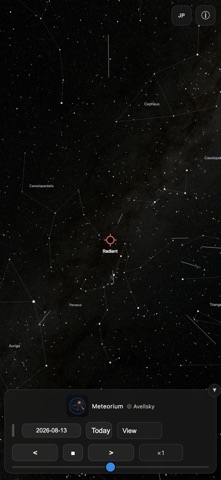
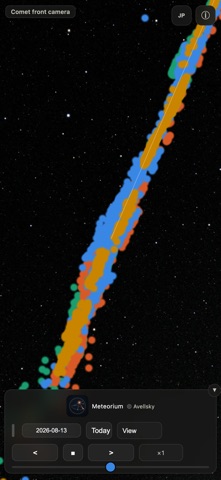
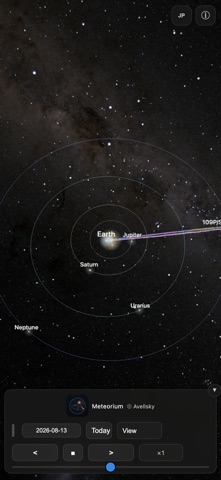
Meteorium is an astronomy app that scientifically visualises the "dust trails" — the ribbons of comet dust that give rise to meteor showers. It shows 60,000 dust grains released by comet 109P/Swift-Tuttle, the parent of the Perseid meteor shower, over its eight perihelion returns from 1079 to 1992. Each grain is ejected from the comet's nucleus around perihelion and followed by full orbital integration including planetary gravity and solar radiation pressure, then rendered in 3D against NASA's all-sky star maps. The comet's position at the moment of ejection is anchored to the JPL Horizons ephemeris, which uses an orbit solution fitted to the observations of each historical apparition. Features: • 3D dust trails coloured by ejection year • Multiple viewpoints (ecliptic north/south, latitude sweep, Sun, ground, comet) plus a free view that tours the highlights every 10 s • Run time forward/backward at 10-10,000x to watch the trails evolve • Realistic Milky Way (NASA Deep Star Maps 2020), constellation lines and names, planets • Japanese / English Why do meteor showers return on the same dates every year? How does comet dust spread through the solar system? Meteorium shows you the three-dimensional structure and its evolution over time — and from the ground view you can simply enjoy the meteor shower itself. The app works fully offline, with no data collection and no ads. A Pro edition — theory computation for every shower, worldwide observation databases, ZHR outburst forecasts, dust-trail cross-sections, recording and image export — is in preparation.
What's new · 1.1
This release opens the paper's own results inside the app. - The Leonid forecasts for 2030-2035 now ship with the app. Each year is computed from a dataset matched to that encounter's epoch, exactly as in the manuscript submitted to Icarus. - "Fetch published data..." has been added to the Model calculation menu. The epoch-matched datasets published with the paper - 1998, 1999, 2000, 2001, 2002 and 2009 - load straight into the app, and choosing one sets the forecast year for you. - The ground view now lets the meteor rate be set to ZHR 100 / 1000 / 5000 / 10000 / 100000, so a storm sky like 1999 can be reproduced. - The viewpoint menu on the bottom bar shows which viewpoint is in effect. - Dataset names are written consistently (epoch and grain count). All computation and rendering still happen on your device. The app goes online only when you choose to fetch the published datasets. No accounts, no purchases, no ads.
Details