

ECG Vector
Takashi Nakano · Education
Independent analytics for this App Store listing. AppTracker is not affiliated with Takashi Nakano.
Chart standing · US
Screenshots




About
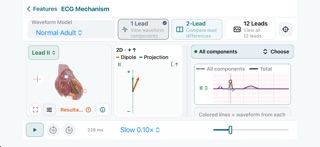
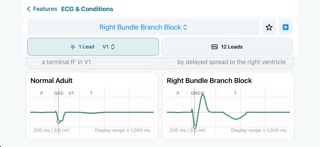
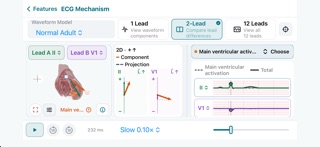
ECG Vector is an educational simulator for exploring how electrical activity in the heart relates to ECG waveforms. Switch between six learning workspaces on Mac, iPhone, and iPad. ECG Mechanism Observe 3D activation and repolarization, the cardiac source vector, and lead-axis projections in sync with the ECG. Use single-lead decomposition, two-lead comparison, and the 12-lead view to understand differences in polarity and shape. Ion & ECG Explore educational approximations linking Na⁺, K⁺, Ca²⁺, H⁺ (pH), and major ion currents to action potentials, ECG measures, and clinical conditions. See differences from the reference alongside explanations. Ventricular Action Potential Numerically simulate a single ventricular cell using Luo–Rudy I (1991). View membrane voltage, Na⁺/Ca²⁺/K⁺ currents, conductances, and gates together. Pause at the peak sodium current and compare with the membrane diagram. Cardiac Rhythm View representative regional action potentials on a shared timeline. Adjust the sinus cycle, conduction speed, and AV delay, and explore schematic examples of normal rhythm, bradycardia, tachycardia, and AV block. ECG & Conditions Compare normal and representative clinical patterns in single-lead or 12-lead views, with explanations of waveform features and their mechanisms. Learn & Quiz Identify patterns from the 12 leads and rhythm strip, then deepen your understanding with explanations. Free access includes Adult Normal and Right Bundle Branch Block, all standard 12 leads, fixed electrode placement, four guided Ion & ECG examples, and comparison and quiz samples. The standard ventricular-cell model, stimulus adjustment, playback, current and gate inspection, and all Cardiac Rhythm features are also free. The one-time ECG Vector Pro purchase unlocks unrestricted Ion & ECG adjustment and its synchronized 12-lead response; ventricular-cell conductance adjustment, suppression presets, and comparison with the standard trace; additional pediatric and clinical patterns; custom leads; electrode editing; and the complete comparison and quiz libraries. This is not a subscription. For education only—not diagnosis, treatment decisions, or patient-specific prediction. Ion & ECG uses educational response approximations; the ventricular-cell model is based on guinea-pig ventricular muscle; Cardiac Rhythm uses waveform templates and activation timings. A single-cell membrane potential is not a surface ECG or a QT interval. No sign-in or external hardware is required.
What's new · 1.3
Learn the mechanisms behind ECGs, from cell currents to cardiac rhythm. - Added Ventricular Action Potential with synchronized Luo–Rudy I membrane voltage, ion currents, and gates. Pause at the sodium-current peak. The standard model and stimulus adjustment are free; conductance adjustment, suppression experiments, and standard-trace comparison are included in the existing Pro purchase. - Added Cardiac Rhythm. Follow activation from the sinus node to the ventricle and adjust sinus cycle, conduction speed, and AV delay. All features, including schematic bradycardia, tachycardia, and AV-block examples, are free. - Expanded Ion & ECG adjustments, including Na⁺ and H⁺ (pH), and clarified clinical connections and differences from the reference. Added voltage ticks and units to the action-potential plot. - Improved single-lead and 12-lead comparisons, including representative pediatric, fever-related heart-rate increase, and higher-BMI examples. ECG Mechanism and comparison selections now remain independent. - Refined pediatric waveforms, bundle-branch conduction, atrial fibrillation, ST changes, and ECG/3D consistency. Included representative P-wave flattening and PR prolongation with high K⁺, and ST depression in the LVH strain pattern. - Refined the 3D heart cutaway. A faintly visible front wall makes depth easier to understand. Atrial activation spreads across the atria, while ventricular conduction is shown as septal bundles and a branching network. - Improved projection vectors on the lead axes and +/− markers, and added 2D diagrams to compare the cardiac electrical vector with its projections. Select leads in the 3D panel and resize the 3D and waveform panels. - Also improved the membrane diagram, two-lead comparison, and playback alignment. Electrode placement includes all 10 electrodes, including neutral RL. - Improved text, buttons, and layouts. Wider screens show quiz waveforms alongside answers and explanations. Refined the iPhone feature list, navigation, and landscape layouts. - Clarified model purposes and limitations, and made phase, gate, and current explanations more accurate when conditions change. Educational models only—not for diagnosis or treatment decisions.
Details