
Chart standing · US
What changed · US
Listing changes AppTracker has observed for this app in this storefront — new versions, price moves, rating shifts, and store copy.
Price & rating history · US
Reconstructed from the listing changes AppTracker has observed in this storefront, so each line starts at the first change on record.
Price · USD
Screenshots


About
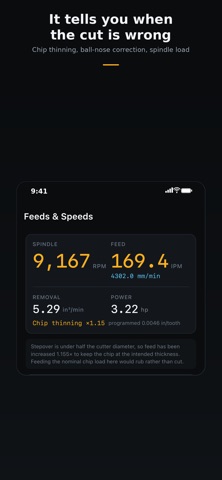
Chipload works out feeds and speeds for milling, turning and drilling, and it does it entirely on your phone. No signal, no account, no subscription, no ads. Buy it once. WHAT IT DOES • Feeds and speeds for milling, with the material actually taken into account. Pick 6061, 4140, 304 stainless, Ti-6Al-4V, cast iron, brass, acrylic, MDF and more — carbide or HSS, and light, general or high-performance setups. • Radial chip thinning. Below half-diameter stepover no tooth ever cuts a chip as thick as the programmed feed, and feeding the nominal chip load rubs instead of cutting. Chipload corrects the feed and tells you it did. • Ball nose effective diameter. A ball engaged 0.050" deep is cutting on a 0.300" circle, not a 1/2" one. Using the nominal diameter under-runs the spindle by more than half. Chipload uses the effective diameter automatically. • Tap drill sizes for UNC, UNF and ISO metric coarse and fine, cut taps and roll taps, at any thread engagement you choose. It names the drill that is actually in your index and tells you the engagement that drill really gives you — never a decimal you cannot buy. • Full drill charts: fractional, number, letter and metric, cross-referenced in inches and millimetres, searchable. Type 0.201 and get the #7; type #7 and get both decimals plus the sizes either side. • Shop math you currently do on a phone calculator: bolt circle coordinates and chord, right triangle solver, chamfer plunge depth, drill point depth, sine bar stacks. • Spindle load, torque and material removal rate. Enter your machine's spindle speed limit, power and maximum feed once, and Chipload warns you when a cut asks for more than you have — with the specific number, not a vague caution. WHY IT IS DIFFERENT Most calculators in this category either ignore the workpiece material entirely, or hide the useful half behind a subscription. Chipload does neither. Every number is computed from ISO and ASME standard formulas at full precision, not from the rounded 3.82 and 0.262 you see on shop posters. Drill sizes, thread geometry and tap drills are computed from the standards rather than copied from a chart, so they are internally consistent to more decimal places than you will ever need. Speed and chip load starting values are consolidated from published tooling manufacturer data and deliberately biased conservative. Where published sources genuinely disagree — aluminium and cast iron cutting force are the worst offenders — the app says so on the material instead of quietly picking a side. And every value is editable. Pick a material to seed the numbers, then overtype the surface speed or chip load with your own proven figures. BUILT FOR A SHOP FLOOR Dark, high-contrast readouts sized to be read at arm's length with safety glasses on. Both unit systems shown at once, so a print in inches and a control in millimetres never needs mental arithmetic. Results at the top of the screen where you look first. PRIVACY Chipload requests no permissions at all, including network. There is nothing to sign into and nothing is collected, because there is no network code in the app to collect it with. That is also why it works identically in a basement shop with no bars. IMPORTANT Chipload gives theoretical starting values for planning. Machine rigidity, tool condition, workholding and coolant all change what is actually safe, and a worn edge can add half again to the cutting force. Always verify against your tool manufacturer's data and start conservative.
Details