

Bhashalu: Learn Hindi-Telugu
Nipun Dubey · Reference
Independent analytics for this App Store listing. AppTracker is not affiliated with Nipun Dubey.
Chart standing · US
What changed · US
Listing changes AppTracker has observed for this app in this storefront — new versions, price moves, rating shifts, and store copy.
A full audit of all 5,000 entries. Every entry was checked and 414 were corrected. The largest group by far: pairs that were marked unrelated but are in fact the same word. Hindi hol and Telugu haalu are both the English word hall. Koyal and kokila are both Sanskrit kokila. Daawa and daavaa are both Arabic da'wa. Those entries now say so, and name the source word. Also corrected: origins that had drifted, a handful of genders, and notes that claimed no common source could be found when one could. Nothing was found claiming a connection that does not exist. Every correction runs the other way, which means the dictionary had been understating what these two unrelated languages actually share.
In-app purchases · US
No in-app purchases.
Screenshots



About
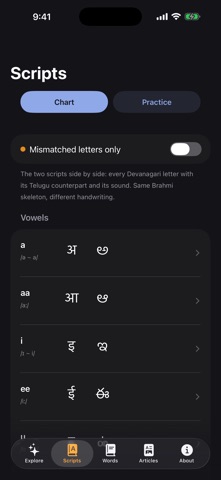
Hindi and Telugu are not related. Hindi is Indo-Aryan. Telugu is Dravidian. They come from different language families, they are not siblings or cousins, and a Telugu speaker and a Hindi speaker do not understand each other by default. And yet the two have lived side by side for a thousand years, quietly trading words. Bhashalu is a dictionary about that traffic: which words crossed, which way they went, and which ones only look related. EVERY ENTRY IS A PAIR, NOT A TRANSLATION An entry holds a Hindi side and a Telugu side, each with its own script, romanization, origin and gender, and a plain statement of how the two relate: one Sanskrit word both languages reached for independently, so neither took it from the other; one Persian or Arabic word borrowed twice through the Deccan; one English word both took recently; or two unrelated words that mean the same thing. That last case is the most common, and Bhashalu says so instead of hunting for a connection that is not there. Nearly three quarters of the entries are marked unrelated, because that is what the language actually looks like. A TUTOR THAT CORRECTS YOU Write a sentence in Telugu, Hindi or plain English letters. The Telugu tutor hands it back gently corrected, explains what changed, translates it, and keeps the conversation going. Replies come in Roman letters, Telugu script or Devanagari. It asks consent before the first message and says where your words go. SONGS, AND WHAT THE LIST MISSES Name a song and Bhashalu explains its language: what the title means, who wrote it, and the harder words one by one, with the Hindi form beside the ones the two genuinely share. Links out to Spotify and YouTube. Commentary only, never reproduced lyrics. When a search finds nothing in the whole dictionary, and only then, Bhashalu offers to work it out. Both are labelled AI-generated and kept on your device. TWO SCRIPTS, ONE CHART Devanagari and Telugu are both grandchildren of Brahmi, so their alphabets line up letter by letter: they are cousins even though the languages are not. The chart runs 57 rows with sound and IPA, and the eleven with no counterpart say so. Practice adds three modes: a letter drill, a mirror match, and real words to read. READ IT, AND HEAR IT Plain romanization hides long vowels and retroflex consonants, so every Telugu word carries a second reading, generated from the script itself, marking both: chettu becomes cheTTu, desham becomes dEsham. Entries and chart letters carry a pronounce button on each side, wherever your phone has the voice; essays have narration. ESSAYS, A DAILY WORD, AND A QUIZ Essays on how the two languages actually met, and more arrive without an update. A word of the day each morning, if you want it. A quiz that asks not just what a word means but how the two sides relate. BUILT THE HONEST WAY Where scholars disagree about where a word came from, the entry says so rather than picking a tidy answer. A wrong etymology is worse than an honest "uncertain", which is a filter of its own. Telugu grammatical gender is modelled properly, not flattened onto Hindi's masculine and feminine: Telugu separates masculine from non-masculine in the singular, and human from non-human in the plural. ALSO - 5,000 entries, bundled in the app - Search either language, either script, English or the reading guide - Filter by origin: Sanskrit, Dravidian, Persian, Arabic, English or Uncertain - Interface in English, Hindi or Telugu; entries stay in English - iPhone and iPad, light or dark - No account, no ads, no tracking - The dictionary, chart, practice and quiz need no connection; the tutor, song breakdowns, AI lookups and essay narration do Bhashalu is the companion to Zubane, which covers Hindi and Urdu. Where Zubane argues that two things people think are separate are really one language, Bhashalu argues the opposite and more interesting case: that two genuinely separate languages can still hand each other a thousand words.
What's new · 1.2
A full audit of all 5,000 entries. Every entry was checked and 414 were corrected. The largest group by far: pairs that were marked unrelated but are in fact the same word. Hindi hol and Telugu haalu are both the English word hall. Koyal and kokila are both Sanskrit kokila. Daawa and daavaa are both Arabic da'wa. Those entries now say so, and name the source word. Also corrected: origins that had drifted, a handful of genders, and notes that claimed no common source could be found when one could. Nothing was found claiming a connection that does not exist. Every correction runs the other way, which means the dictionary had been understating what these two unrelated languages actually share.
Details