

Lastscript
Yiwen Luo · Education
Independent analytics for this App Store listing. AppTracker is not affiliated with Yiwen Luo.
Chart standing · US
In-app purchases · US
No in-app purchases.
Screenshots



About
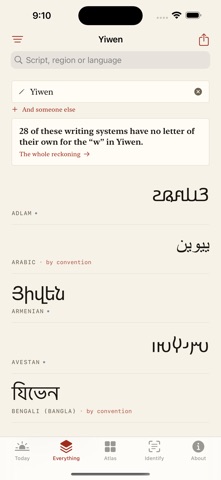
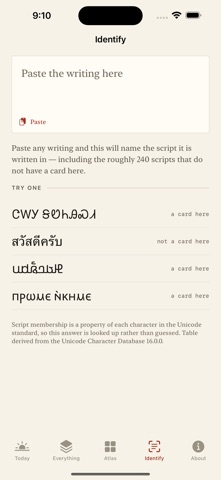
One writing system a day, and your own name written in it. Every morning Lastscript opens on a different way of writing: Adlam, invented by two teenage brothers in Guinea; Ogham, cut along the edges of standing stones; Tamil, which does not write the difference between p and b because Tamil does not hear one. You get its story, its record, the whole of its alphabet — and your own name set in it, in a real typeface. WHAT MAKES IT DIFFERENT Eight of the sixty-five cards will not write your name, and say why. Linear A and Cypro-Minoan because nobody can read them. Cherokee because it has no letter for half the sounds in English. Khipu because it is knotted cord, not writing. SignWriting because a name sign is given by a Deaf community, not generated by an app. Those refusals are the most interesting cards here. Everywhere else, the app tells you exactly what kind of answer it is giving. Thirty-seven scripts write your name letter for letter. Twenty write it by a stated convention — Arabic and Hebrew drop your short vowels, Japanese adds ones you never had, Chinese picks characters that mean something whether you like it or not. Every card names the convention it followed. WHAT IS IN IT • Your name in 65 writing systems at once, as a sheet, a PDF, a poster or plain text • Trace any letter — or your whole name — over the letterform with your finger, and keep what you drew • The letters: every script's whole alphabet, each sign with the sound it writes and its Unicode name • A quiz over those letters that remembers the ones you keep missing, and builds a review from them • The numbers: fourteen of these scripts count in signs of their own, with today's date written in them • Identify — paste any writing and be told what script it is, across roughly 240 of them • Find a sound — which writing systems have a letter for "th", or "kh", or "ng" • Search inside all 65 stories • Five thousand years — your name from 3200 BC to 2015, one row per script • Where each script came from, and the whole family on one screen • Any two scripts side by side, with the differences worked out • Hear the reading aloud, or the whole story • A wallpaper, Home Screen and Lock Screen widgets, Shortcuts actions, and a daily reminder if you want one ABOUT BEING WRONG Being wrong about somebody's name in their own script is the error this app most wants to avoid. Every glyph is resolved by its Unicode character name when the app is built, so a typo fails the build instead of shipping. Where a script has no sign for a sound, the app says so on screen instead of quietly substituting. Every syllable-built render shows the reading it worked from. It will still be wrong sometimes, particularly for names whose spelling and sound part company. That is why the reading is always visible, and why every card that made a judgement call says so. PRIVACY The whole catalog and all 39 typefaces are inside the app. Lastscript makes no network requests at all, has no account, and collects nothing. Your name never leaves your device. Letterforms from the Noto project under the SIL Open Font License 1.1. Script inventory from ISO 15924 and the Unicode Character Database.
Details