

New Quark Theory Elements
David Nishimoto · Business
Independent analytics for this App Store listing. AppTracker is not affiliated with David Nishimoto.
Chart standing · US
In-app purchases · US
No in-app purchases.
Screenshots


About
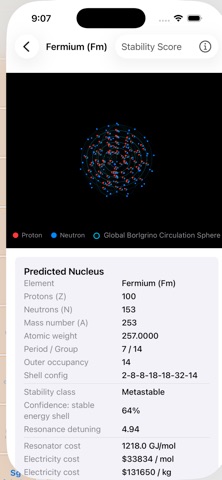
Shell Organization — 10% Checks how full the outermost shell is relative to capacity (2, 8, 8, 18, 18, 32, 32, 50). A shell isn't a physical location but a resonance condition. Partially filled shells leave "open slots" in the lattice's pattern, meaning the structure hasn't settled into its lowest-correction state. A shell at capacity needs no further rearrangement to stay coherent. Weighted low (10%) because shell completeness is secondary—it shows the outer boundary is tidy but says nothing about internal quark-level physics (spin, current, energy). A full outer shell can sit atop an internally chaotic lattice. Resonance Closure — 25% Measures proximity to three "sweet spots": Z=1 (hydrogen), Z≈26 (iron), or Z≈126 (heavy-element closure). The model treats certain proton counts as inherently more likely to produce organized lattices—the geometry "wants" to close cleanly at those points, similar to magic numbers in nuclear shell theory. Tied for highest weight (25%) because it's the most structural check—about where the nucleus sits on the periodic map, not just internal machinery performance. A nucleus near Z=26 gets a strong stability prior regardless of small fluctuations. Quark Twister Resonance — 25% From NuclearLatticeEngine, captures how well proton/neutron quark lattices—spin alignment, geometric symmetry, twist coupling—hold together internally. This is the most "first-principles" measurement: current, frequency, and energy are downstream of quark synchronization. Incoherent quark twist means nothing above is trustworthy. Shares top weight (25%) with Closure—one captures structural position, the other captures correct internal physics. Together they're half the score. Internal Current Flow — 15% Current represents organized internal energy circulation from Quark Twister rotation—not external electric current, but the lattice's own energy flowing stably. normalizedCurrent compares actual current against canonical expectations. Deviation either way (sluggish or over-driven) signals correction needs. 15% reflects it's a meaningful but secondary consequence of good twister resonance: high twister scores usually mean near-canonical current, so it's partly confirmatory. Resonance Energy Efficiency — 10% Each configuration has a "preferred" energy cost scaled by assembled lattices (protons + neutrons). Energy far above or below baseline means the lattice is over-energized or under-supported—inefficient either way, requiring more correction. Sits at 10% because, like current, it's largely downstream of twister/geometry quality—a well-resonating lattice naturally lands near expected energy. Quark Twister Frequency Alignment — 5% The "in-tune instrument" check—how close actual rotational frequency is to a perfectly synchronized lattice's expected frequency. Similar to Current and Energy (all measure deviation from canonical baseline), but frequency is the most abstract/least consequential alone. Smallest weight (5%) deliberately—misalignment is real signal, but tightly correlated with Twister Resonance (25%), so larger weight would double-count the same physics. Neutron–Proton Balance — 10% Checks whether N/Z sits near the ideal ratio (1.0 + Z*0.004—creeping upward for heavier elements, mirroring how real nuclei need more neutrons to offset proton-proton strain). Too few neutrons means insufficient structural "padding"; too many means excess unpaired mass outside tight binding. 10% reflects it's a real, independent structural constraint (unlike current/energy/frequency)—but coarser, population-level versus the fine-grained physics of Twister Resonance and Closure. Forbidden Pair Penalty (×0.4) Not part of the weighted sum—applied after, multiplying the subtotal by 0.4 if Z–N is flagged. Some proton-neutron combinations produce poor symmetry regardless of individual scores, treated as a known bad-combination effect requiring a blanket correction outside the weighted average.
Details