
Chart standing · US
What changed · US
Listing changes AppTracker has observed for this app in this storefront — new versions, price moves, rating shifts, and store copy.
Recognition thresholds are now verified on real clinical photographs — not estimated. The verification series exposed seven faults you would otherwise have met in the field: a fresh livid bruise dropped out of recognition, a resorbing haematoma carried no evidence of blood, and solar lentigo was rejected outright — although melanin adds yellow while blood takes it away. Recognition now covers most of the atlas: petechiae, cyanosis, Mongolian spot, second-degree burn blisters, haemangioma, post-inflammatory pigmentation, pustules, scaly dermatoses, exanthems, putrefactive change, electrical marks and ligature furrows. Atlas expanded to 67 findings — a new "Benign skin growths" category: warts, molluscum contagiosum and skin tags, each with its forensic pitfalls. Forensic mode stays focused on injuries: a non-traumatic finding (mole, keratosis, wart) is still recognised, but capped at 60 % and referred to the dermatological mode. A new examination question: bleeding from the lesion — it excludes flat macules outright. Reference fingerprints: measurements are compared against fingerprints taken from verified photographs, and every match shows its source. Fingerprints can be imported and exported (.ch3lab). Atlas search in both languages at once, value copying by long-pressing the colour swatch, haptic feedback, a clearer Info tab, and a new icon: the colour fog of the skin brought into focus by the diagnostic loupe. A welcome screen on first launch; the language follows the device — Slovak only on a Slovak device, English everywhere else. Fixed Slovak localisation — some headings appeared in English while the app was set to Slovak. Verified by 202 regression tests.
Screenshots



About
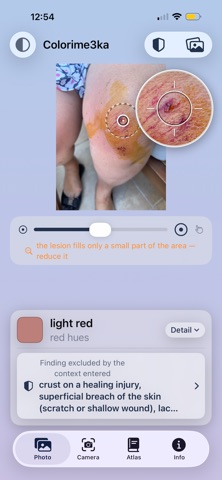
Colorime3ka measures and names the colour of a skin finding from a photograph or the live camera. It was created for forensic and dermatological documentation, where a precise, repeatable description of colour decides the quality of the record. WHAT DECIDES IS THE CHROMOPHORE Not the colour itself, but which substance causes it. Melanin darkens the whole area and keeps a yellow-brown hue. Haemoglobin adds colour but barely darkens the skin, because the blood lies beneath an intact epidermis. Dried blood has a very dark red-brown core. A scar is recognised by what it lacks — no dark component, no skin markings. MEASUREMENT • Robust colour of the area (median of channels), converted to CIELAB, named by ΔE (CIEDE2000) • Uniformity, sharpness of the margin, surface roughness, outline and the hue gradient from centre to edge • Adjustable measurement area with a reticle that also frames the surrounding skin CALIBRATION AND SCALE • Grey card — removes the colour cast of the lighting • Colour chart (24 patches) — a 3×3 correction matrix in linear RGB, for comparable series • Scale in millimetres from two taps on a ruler TWO ASSESSMENT MODES Forensic — bruise, abrasion, wounds, crusts and scars, erythema, vitality and dating. Dermatological — pigmented lesions and melanoma by ABCDE, efflorescences, inflammatory and vascular changes. CLINICAL CONTEXT The photograph does not carry what most often decides. The app therefore asks: state of the subject, history of trauma, duration, whether the skin is broken, whether the lesion blanches under pressure, skin markings, level and distribution. Factually impossible combinations are excluded outright and the reason is stated. ATLAS OF 67 FINDINGS Bilingual, with original schematic drawings: mechanical injuries, thermal and electrical injuries, healing, pigmented lesions, efflorescences, post-mortem changes, and body modifications and traditional practices — including findings regularly mistaken for abuse. FOR RESEARCH CSV export of every measured quantity, including the conditions under which it was obtained. WHAT IT DOES NOT DO The app gives no diagnosis and is not a medical device. Percentages express the agreement of measured features with reference criteria, not diagnostic certainty; the ceiling is 85 %. The age of a bruise cannot be determined with certainty from colour — the app states this openly instead of hiding it. The decision always belongs to the physician. Fully localised in Slovak and English.
What's new · 2.7
Recognition thresholds are now verified on real clinical photographs — not estimated. The verification series exposed seven faults you would otherwise have met in the field: a fresh livid bruise dropped out of recognition, a resorbing haematoma carried no evidence of blood, and solar lentigo was rejected outright — although melanin adds yellow while blood takes it away. Recognition now covers most of the atlas: petechiae, cyanosis, Mongolian spot, second-degree burn blisters, haemangioma, post-inflammatory pigmentation, pustules, scaly dermatoses, exanthems, putrefactive change, electrical marks and ligature furrows. Atlas expanded to 67 findings — a new "Benign skin growths" category: warts, molluscum contagiosum and skin tags, each with its forensic pitfalls. Forensic mode stays focused on injuries: a non-traumatic finding (mole, keratosis, wart) is still recognised, but capped at 60 % and referred to the dermatological mode. A new examination question: bleeding from the lesion — it excludes flat macules outright. Reference fingerprints: measurements are compared against fingerprints taken from verified photographs, and every match shows its source. Fingerprints can be imported and exported (.ch3lab). Atlas search in both languages at once, value copying by long-pressing the colour swatch, haptic feedback, a clearer Info tab, and a new icon: the colour fog of the skin brought into focus by the diagnostic loupe. A welcome screen on first launch; the language follows the device — Slovak only on a Slovak device, English everywhere else. Fixed Slovak localisation — some headings appeared in English while the app was set to Slovak. Verified by 202 regression tests.
Details