
Chart standing · US
What changed · US
Listing changes AppTracker has observed for this app in this storefront — new versions, price moves, rating shifts, and store copy.
AVECT 1.1.0 completely refreshes the core vehicle-state engine. Speed, position, rail segment, and grade now run consistently through one event-driven chain. - Velocity: trustworthy GNSS remains the absolute speed reference. IMU use is bounded to observable launch detection and short bridging between GNSS updates. Delayed GNSS is reconciled at measurement time, with explicit handling for outliers, outages, stop recovery, and uncertainty. Stale low-quality fixes can no longer establish a cold-start speed by themselves. - Position: accepted velocity is integrated downstream and corrected by GNSS position. Distance and position uncertainty are tracked, with no feedback from position or station context into speed. - Rail segments: when AVECT is opened mid-journey, one clear valid GNSS fix on an unambiguous single-line alignment can show a direction-free “Station A—Station B” segment without prior station history or a confirmed previous station. Direction can be established later from course or additional observations; parallel tracks, junctions, close alignments, and tied candidates remain withheld. - Altitude and vertical speed: GNSS provides a slowly corrected altitude datum while fine pressure-height changes remain responsive. Vertical speed in m/min and ft/min makes indoor and elevator movement observable. When aircraft cabin pressure causes a large disagreement, pressure altitude is rejected and GNSS altitude takes priority. - Grade: changes in barometric altitude are checked against GNSS altitude, then estimated robustly over distance. A grade-only shield excludes cabin-pressure changes correlated with acceleration and braking, and a clear GNSS/barometer trend disagreement withholds the value. Grade never feeds back into speed or position. - Logging and Guide: each recording now saves speed, position, sensor, and estimator-state data in one CSV file. GUIDE now documents segment Quick Look, the estimator chain, communications, and privacy. - Subscription: entitlement is checked before network-backed product metadata at launch, so active subscribers enter the app without passing through the purchase screen. Product-loading retry and safer measurement/CSV finalisation during access transitions are also included.
Price & rating history · US
Reconstructed from the listing changes AppTracker has observed in this storefront, so each line starts at the first change on record.
Price · USD
Screenshots


About
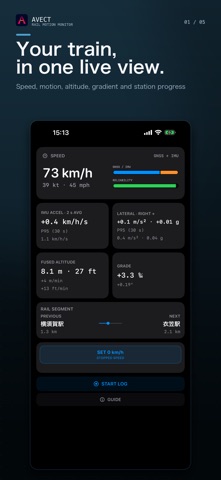
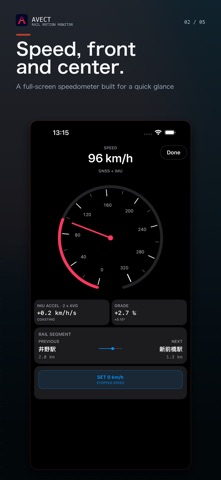
AVECT is a real-time rail journey monitor that lets you experience how a train moves through live measurements. When a train departs, the IMU detects motion before the next GNSS speed update arrives, allowing the speed display to respond quickly. If GNSS reception is interrupted in a tunnel or underground section, AVECT uses the last trustworthy GNSS speed as its reference and IMU data to bridge the vehicle’s motion and keep the speed display going. Once GNSS becomes stable again, the estimate is corrected toward GNSS speed. AVECT displays not only speed, but also station names, current location, forward and lateral acceleration, altitude, vertical speed, and grade. It lets you follow the train’s motion through numbers, including during departures that GNSS alone may not detect immediately and sections where GNSS reception is limited. FUSED altitude responds to fine changes detected by the barometer, while vertical speed is displayed in both m/min and ft/min. These readings let you observe mountain passes, entry into underground sections, elevators, aircraft, and other vertical movement. Absolute altitude is a GNSS-based reference value and may not match surveyed elevation or exact altitude above mean sea level. Grade is conservatively estimated from distance traveled and barometric and GNSS altitude data. Cabin pressure fluctuations caused by acceleration or braking, as well as pressure readings that clearly disagree with GNSS altitude, are excluded from the grade display. The acceleration of a high-speed train. The grade of a mountain pass. The motion of a train entering an underground section. AVECT turns an ordinary rail journey into a trip experienced through numbers. Speed, acceleration, altitude, vertical speed, and other measurements can also be enjoyed on aircraft, ships, cars, and other forms of transportation. Try AVECT free for the first 7 days. After the free trial ends, access continues through an auto-renewable subscription. Terms of Use (Apple Standard EULA): https://www.apple.com/legal/internet-services/itunes/dev/stdeula/
What's new · 1.1.0
AVECT 1.1.0 completely refreshes the core vehicle-state engine. Speed, position, rail segment, and grade now run consistently through one event-driven chain. - Velocity: trustworthy GNSS remains the absolute speed reference. IMU use is bounded to observable launch detection and short bridging between GNSS updates. Delayed GNSS is reconciled at measurement time, with explicit handling for outliers, outages, stop recovery, and uncertainty. Stale low-quality fixes can no longer establish a cold-start speed by themselves. - Position: accepted velocity is integrated downstream and corrected by GNSS position. Distance and position uncertainty are tracked, with no feedback from position or station context into speed. - Rail segments: when AVECT is opened mid-journey, one clear valid GNSS fix on an unambiguous single-line alignment can show a direction-free “Station A—Station B” segment without prior station history or a confirmed previous station. Direction can be established later from course or additional observations; parallel tracks, junctions, close alignments, and tied candidates remain withheld. - Altitude and vertical speed: GNSS provides a slowly corrected altitude datum while fine pressure-height changes remain responsive. Vertical speed in m/min and ft/min makes indoor and elevator movement observable. When aircraft cabin pressure causes a large disagreement, pressure altitude is rejected and GNSS altitude takes priority. - Grade: changes in barometric altitude are checked against GNSS altitude, then estimated robustly over distance. A grade-only shield excludes cabin-pressure changes correlated with acceleration and braking, and a clear GNSS/barometer trend disagreement withholds the value. Grade never feeds back into speed or position. - Logging and Guide: each recording now saves speed, position, sensor, and estimator-state data in one CSV file. GUIDE now documents segment Quick Look, the estimator chain, communications, and privacy. - Subscription: entitlement is checked before network-backed product metadata at launch, so active subscribers enter the app without passing through the purchase screen. Product-loading retry and safer measurement/CSV finalisation during access transitions are also included.
Details