

The Grand Orrery
CRAIG ANTHONY PERKINS · Education
Independent analytics for this App Store listing. AppTracker is not affiliated with CRAIG ANTHONY PERKINS.
Chart standing · US
What changed · US
Listing changes AppTracker has observed for this app in this storefront — new versions, price moves, rating shifts, and store copy.
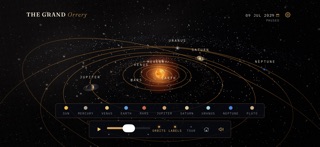
Travel in time. The planets no longer just drift forward. The speed slider now has a stop in the middle: push it right to run the solar system forward, pull it left to run it backward, and the further you go the faster time moves. Stop at the center and tap the date to jump anywhere between 1800 and 2050. And the positions are now real. Every planet is placed using NASA JPL's orbital elements, so the arrangement you see on any date is the arrangement the sky actually had. Orbits are true ellipses, so the planets speed up near the sun and slow down far from it, and Pluto's path visibly dips inside Neptune's, exactly as it did between 1979 and 1999. Find the day you were born. Watch the planets line up. Then run it backward and watch it come apart.
In-app purchases · US
No in-app purchases.
Screenshots



About
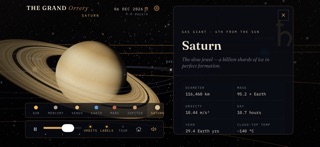
No subscriptions. No ads. No accounts. The whole solar system. The Grand Orrery is a hand-built model of our solar system, drawn in the style of an antique astronomical atlas and powered by a native Metal renderer. Twenty-five worlds — the Sun, every planet, Pluto, and fifteen notable moons — spin and orbit in real time. Tap any of them and the camera sweeps you to its sunlit side while its field-guide dossier slides up: measurements, atmosphere, notable moons, and the kind of margin notes an astronomer would actually tell you at the eyepiece. Every world's surface is generated on your phone — except Earth, which wears NASA's own Blue Marble portrait — and every figure in every dossier was verified against NASA and JPL references, with the sources one tap away. - Pinch, drag, and fly through a living orrery rendered at up to 120 fps - Field-guide dossiers for 25 worlds, checked against NASA and JPL - The Grand Tour: sit back while the orrery visits each world in turn - A quiet, generated ambient soundscape (leave it on or switch it off) - Orbit lines, floating labels, adjustable time — from hours to years per second — and a pause button when you just want to look - Sources for every world, cited in the app - Works completely offline; collects nothing Buy it once. Keep the solar system in your pocket.
What's new · 1.2.0
Travel in time. The planets no longer just drift forward. The speed slider now has a stop in the middle: push it right to run the solar system forward, pull it left to run it backward, and the further you go the faster time moves. Stop at the center and tap the date to jump anywhere between 1800 and 2050. And the positions are now real. Every planet is placed using NASA JPL's orbital elements, so the arrangement you see on any date is the arrangement the sky actually had. Orbits are true ellipses, so the planets speed up near the sun and slow down far from it, and Pluto's path visibly dips inside Neptune's, exactly as it did between 1979 and 1999. Find the day you were born. Watch the planets line up. Then run it backward and watch it come apart.
Details