

Buildguise: Cosplay Studio
Robert Corbin · Lifestyle
Independent analytics for this App Store listing. AppTracker is not affiliated with Robert Corbin.
Chart standing · US
What changed · US
Listing changes AppTracker has observed for this app in this storefront — new versions, price moves, rating shifts, and store copy.
Here is the whole of 2.0, in the order you will meet it. 1. Pick the joint, then the motion. The app names the segment the phone goes on, upper arm, forearm, thigh or shin, and reads you its mounting line word for word, because a phone measures the segment it is strapped to and nothing beyond it. 2. Stand still for two seconds. That gives us your gravity reference, and every angle afterwards is read from there. How still you actually were is measured too, and travels with the take instead of being thrown away. 3. Run the motion. We wrote six scripts: arms overhead, a back-scabbard draw, sitting down into a firm chair, reaching your face for water, stairs, and getting the piece off unaided. We sample a hundred times a second and keep the entire curve, so you get the peak your draw truly reached and, held apart from it, the band your arm lives in across eight hours on the floor. Perform one twice and the tighter take is what the geometry has to clear, with the disagreement left on screen rather than averaged away. 4. Draw the stack. You work on a cross-section of your own limb, with girth, padding, joint centre and up to seven lames, dragging leading and trailing edges, standoffs, return lips, pivots, and the joint-centre path underneath them. We derive every number from that geometry. 5. Sweep. We march your recording through the stack frame by frame and rotate each lame about your pivot along a joint centre that shifts as it goes, reshaped from published measurements and labelled as approximated where that is what it is. Then we bisect to the exact degree at which the stack runs out of travel against a neighbour's return or climbs into its inner face, drops under your gape line onto the undersuit, pinches a limb thicker flexed than relaxed, or clips a helmet or gorget you have placed alongside it. 6. Read the verdict as a mechanism. The pauldron that ships with it binds at 116 degrees, lame 3 into lame 2's inner face, twenty-six short of the sword draw sitting beside it. We light that contact point in a cross-section you scrub with your own motion, and draw the gap at life size beside a bar of the sheet the lame is cut from. That last part needs a display whose pixel pitch we hold; on one we do not, we say so and draw no bar, a bar at the wrong size being worse than none. 7. Take the cheapest fix. We rank the changes that clear your envelope by how much rework each one costs, from re-drilling a single hole up to re-cutting the whole stack. On the shipped drawing a single hole does it, lame 3's pivot two millimetres outboard, and that one clears the dwell band as well. 8. Prove us wrong on cardboard. Tape a scrap mock together, strap the phone back on, and a needle follows your limb against the clear band and changes colour as bind comes up. Two things we refuse to smooth over. If your torso leaned or the strap slipped, we draw it on the curve for you to cut out. Where a pass depends on foam compressing, we label the allowance and show the verdict with it and without it: that same pauldron stops at 116 rigid and reaches 156 once EVA 6 is allowed to squash. An angle you type by hand keeps that label permanently. Recording a take is what raises the motion prompt, and 2.0 asks for nothing else. Capture wants a real device. Where there is no motion hardware the needle is driven by a recorded sweep instead, and it says on screen that this is what it is doing.
Price & rating history · US
Reconstructed from the listing changes AppTracker has observed in this storefront. A field is charted once it has changed more than once, and each line starts at the value it moved from.
Price · 2.99 USD now · 3 changes on record
Screenshots




About
Buildguise is a private cosplay production studio from first reference to convention repair kit. Break a costume into garment, armor, prop, wig, makeup, electronics, and packing parts. Track materials, vendors, measurements, budget, work sessions, dependencies, and completion. Forecast required build pace, rehearse a convention pack, preserve wear-test and repair notes, and export a local build bible. KEY FEATURES - Reference-to-part build breakdown - Material, vendor, measurement, budget, and session records - Completion, days, hours, and pace forecast - Convention packing, wear-test, and repair queues - Searchable 90-plate offline studio guide - Local PDF build bible - No account, ads, analytics, tracking, subscription, or network requirement Buildguise supports planning only. Follow current material, tool, electrical, prop, travel, and venue requirements.
What's new · 2.0
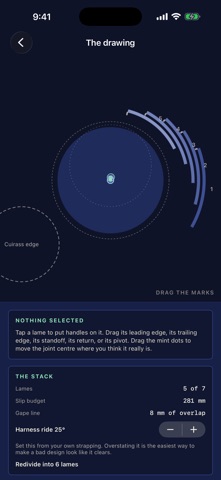
Here is the whole of 2.0, in the order you will meet it. 1. Pick the joint, then the motion. The app names the segment the phone goes on, upper arm, forearm, thigh or shin, and reads you its mounting line word for word, because a phone measures the segment it is strapped to and nothing beyond it. 2. Stand still for two seconds. That gives us your gravity reference, and every angle afterwards is read from there. How still you actually were is measured too, and travels with the take instead of being thrown away. 3. Run the motion. We wrote six scripts: arms overhead, a back-scabbard draw, sitting down into a firm chair, reaching your face for water, stairs, and getting the piece off unaided. We sample a hundred times a second and keep the entire curve, so you get the peak your draw truly reached and, held apart from it, the band your arm lives in across eight hours on the floor. Perform one twice and the tighter take is what the geometry has to clear, with the disagreement left on screen rather than averaged away. 4. Draw the stack. You work on a cross-section of your own limb, with girth, padding, joint centre and up to seven lames, dragging leading and trailing edges, standoffs, return lips, pivots, and the joint-centre path underneath them. We derive every number from that geometry. 5. Sweep. We march your recording through the stack frame by frame and rotate each lame about your pivot along a joint centre that shifts as it goes, reshaped from published measurements and labelled as approximated where that is what it is. Then we bisect to the exact degree at which the stack runs out of travel against a neighbour's return or climbs into its inner face, drops under your gape line onto the undersuit, pinches a limb thicker flexed than relaxed, or clips a helmet or gorget you have placed alongside it. 6. Read the verdict as a mechanism. The pauldron that ships with it binds at 116 degrees, lame 3 into lame 2's inner face, twenty-six short of the sword draw sitting beside it. We light that contact point in a cross-section you scrub with your own motion, and draw the gap at life size beside a bar of the sheet the lame is cut from. That last part needs a display whose pixel pitch we hold; on one we do not, we say so and draw no bar, a bar at the wrong size being worse than none. 7. Take the cheapest fix. We rank the changes that clear your envelope by how much rework each one costs, from re-drilling a single hole up to re-cutting the whole stack. On the shipped drawing a single hole does it, lame 3's pivot two millimetres outboard, and that one clears the dwell band as well. 8. Prove us wrong on cardboard. Tape a scrap mock together, strap the phone back on, and a needle follows your limb against the clear band and changes colour as bind comes up. Two things we refuse to smooth over. If your torso leaned or the strap slipped, we draw it on the curve for you to cut out. Where a pass depends on foam compressing, we label the allowance and show the verdict with it and without it: that same pauldron stops at 116 rigid and reaches 156 once EVA 6 is allowed to squash. An angle you type by hand keeps that label permanently. Recording a take is what raises the motion prompt, and 2.0 asks for nothing else. Capture wants a real device. Where there is no motion hardware the needle is driven by a recorded sweep instead, and it says on screen that this is what it is doing.
Details