

Keebwright: Keyboard Builds
Robert Corbin · Lifestyle
Independent analytics for this App Store listing. AppTracker is not affiliated with Robert Corbin.
Chart standing · US
What changed · US
Listing changes AppTracker has observed for this app in this storefront — new versions, price moves, rating shifts, and store copy.
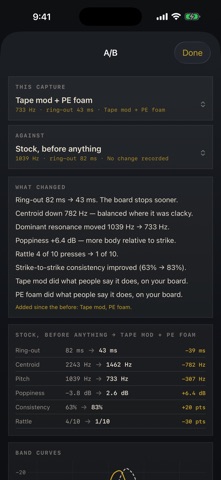
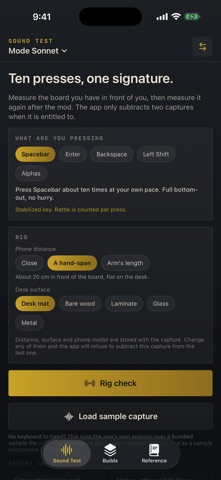
"Can it hear the difference, or am I supposed to?" That arrived from someone halfway through a foam mod, and this update exists because the honest answer used to be the second one. Sound Test now opens the app. Put the phone face up a hand-span from the board, give it two seconds of room tone so it can judge whether it is able to hear anything worth hearing, then hit one key about ten times at your normal pace. The strikes are pulled out of the audio separately, then averaged into a signature that stays with the build: dominant pitch in hertz, a position on the thock-to-clack scale, ring-out in milliseconds, poppiness, and a third-octave curve under all of it. "Does it catch stab rattle, or only the click?" On spacebar, Enter, Backspace and left Shift it counts rattle press by press, so three of ten presses before the mod and one of ten after stops being an argument you have with yourself. Type your alphas normally and you get spread across the ten strikes, which is where a loose keycap fit or a switch lubed at the tired end of the batch shows itself. "How do I see what changed?" Two signatures from the same board open together, band curves overlaid, differences written out as sentences. Where the captures came off different setups, or their room floors sit more than 6 dB apart, the comparison is refused and the reason given, because what you would be reading is two rooms. "Is my typing being recorded?" The audio is analysed and discarded. A thirty-band spectrum, a short envelope outline and a few measured figures per strike survive, filed with the build they belong to. Microphone access is asked for when you start your first session and at no other point. The estimator that used to open the app, and the demand chart drawn from it, are retired. Pack and spares math moved inside the build record, where you were doing it anyway. A demo capture and a matched pair of signatures ride along, one tap behind Load sample capture, so the feature can be tried with nothing plugged in.
Price & rating history · US
Reconstructed from the listing changes AppTracker has observed in this storefront. A field is charted once it has changed more than once, and each line starts at the value it moved from.
Price · 2.99 USD now · 3 changes on record
In-app purchases · US
No in-app purchases.
Screenshots



About
Keebwright is a private mechanical-keyboard build studio for parts, layouts, switch stock, modifications, and costs. Map a board by row, record switch and stabilizer choices, count extras, compare packs with required keys, preserve PCB, plate, foam, tape, spring, lube, keycap, and firmware notes, see landed build cost, and export a local build card. KEY FEATURES - Keyboard project and parts inventory - Visual layout and switch map - Required switch, spare, pack, and cost calculation - Mods, firmware-layer notes, and build checkpoints - Searchable 90-plate offline build guide - Local PDF build card - No account, ads, analytics, tracking, subscription, or network requirement Keebwright records your plan. Confirm physical, electrical, firmware, battery, and component compatibility with authoritative sources.
What's new · 2.0
"Can it hear the difference, or am I supposed to?" That arrived from someone halfway through a foam mod, and this update exists because the honest answer used to be the second one. Sound Test now opens the app. Put the phone face up a hand-span from the board, give it two seconds of room tone so it can judge whether it is able to hear anything worth hearing, then hit one key about ten times at your normal pace. The strikes are pulled out of the audio separately, then averaged into a signature that stays with the build: dominant pitch in hertz, a position on the thock-to-clack scale, ring-out in milliseconds, poppiness, and a third-octave curve under all of it. "Does it catch stab rattle, or only the click?" On spacebar, Enter, Backspace and left Shift it counts rattle press by press, so three of ten presses before the mod and one of ten after stops being an argument you have with yourself. Type your alphas normally and you get spread across the ten strikes, which is where a loose keycap fit or a switch lubed at the tired end of the batch shows itself. "How do I see what changed?" Two signatures from the same board open together, band curves overlaid, differences written out as sentences. Where the captures came off different setups, or their room floors sit more than 6 dB apart, the comparison is refused and the reason given, because what you would be reading is two rooms. "Is my typing being recorded?" The audio is analysed and discarded. A thirty-band spectrum, a short envelope outline and a few measured figures per strike survive, filed with the build they belong to. Microphone access is asked for when you start your first session and at no other point. The estimator that used to open the app, and the demand chart drawn from it, are retired. Pack and spares math moved inside the build record, where you were doing it anyway. A demo capture and a matched pair of signatures ride along, one tap behind Load sample capture, so the feature can be tried with nothing plugged in.
Details