

Petalbatch: Floral Recipes
Robert Corbin · Business
Independent analytics for this App Store listing. AppTracker is not affiliated with Robert Corbin.
Chart standing · US
What changed · US
Listing changes AppTracker has observed for this app in this storefront — new versions, price moves, rating shifts, and store copy.
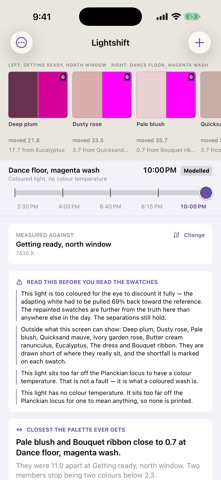
Noon sunlight and a room under twelve candles are not the same light at two strengths. They are different spectra, and the second one has almost no blue in it for a petal to send back. A flower can only return what arrives. So a palette that reads as four separate colors beside a north window can read as two by 8:15, and your eye, which adapts to the cast inside a minute, will not mention that it happened. Lightshift exists to put that hour in front of you in March. Members go into a well as physical bodies, flowers carrying face, reverse and center values and the spread a batch arrives with, along with the dress, the ribbon, the linen and the tabletop, and they are rendered under scenes you build. Outdoor scenes are computed from first principles: solar position at the venue's coordinates and date, resolved into a daylight, open-shade or tent-filtered spectrum. Indoor light is described by fixture type, color temperature and gel. Findings are relational, so they move when the set moves, and the whites get a view of their own, since an all-white palette is where this goes wrong most often. A substitution candidate is ranked by the worst separation it holds across every scene you defined, which is a different ordering from the one you get comparing stems on the bench. The stem-to-bunch calculator that used to occupy this screen has been retired. It multiplied arrangements by stems, added a reserve, divided by supplier bunch size and framed a quote: ninety seconds of arithmetic, once per event, and nobody opened it twice. What sits underneath Lightshift is reference data: the CIE 1931 two-degree observer, illuminants from Planck's law for tungsten and candlelight and from the D-series basis for daylight at any color temperature, lamp and LED models whose band weights are fitted at load until each white lands on the color temperature it claims, and a deliberately small set of florist color families. No invented variety spec sheets, and no commercial swatch system quoted by name or number. Nothing leaves as a document. Pushing a color verdict through an uncalibrated print pipeline and then handing a client the result as evidence would be wrong every time, so the palette stays on the phone lying face-up on the table at the walkthrough. Color renders through Display P3, anything falling outside the gamut gets a flag on it, and clipping is never done silently. Every finding is written out as well as drawn, so nothing depends on seeing hue. The ephemeris follows NOAA's solar-position algorithm and is held to astronomy rather than to itself: solstice declination, the extremes of the equation of time, the solar-noon elevation identity from Edinburgh to Cape Town, an hour that spring forward deletes, and a Sydney December. Delta E 2000 answers the published 34-pair conformance set, and the reflectance reconstruction round-trips under D65 inside a tight tolerance. New icon, a painted dahlia with its own shifted ghost standing a step behind it, and a deep violet for the app tint. A venue comes off a short list of seven or gets typed in with its latitude, longitude and time zone, so the update needs nothing new from your device.
Price & rating history · US
Reconstructed from the listing changes AppTracker has observed in this storefront. A field is charted once it has changed more than once, and each line starts at the value it moved from.
Price · 2.99 USD now · 3 changes on record
In-app purchases · US
No in-app purchases.
Screenshots


About
Petalbatch is an offline floral planning desk for independent florists, hobbyists, students, and small studios. Define bouquets, personals, centerpieces, installations, and ceremony recipes. Roll every recipe into total stems and purchasable bunches, include a user-set reserve, compare substitutions, expose wholesale and labor cost, plan bucket and production stages, and export a local event brief. KEY FEATURES - Arrangement recipes and event quantity rollup - Stem-to-bunch purchasing calculator - Substitution, reserve, labor, and quote modeling - Bucket, prep, production, and load-out queue - Searchable 90-plate offline floral guide - Local PDF event brief - No account, ads, analytics, tracking, subscription, or network requirement Petalbatch is an estimator. Confirm live availability, pack sizes, handling, and final quantities with suppliers and your production team.
What's new · 2.0
Noon sunlight and a room under twelve candles are not the same light at two strengths. They are different spectra, and the second one has almost no blue in it for a petal to send back. A flower can only return what arrives. So a palette that reads as four separate colors beside a north window can read as two by 8:15, and your eye, which adapts to the cast inside a minute, will not mention that it happened. Lightshift exists to put that hour in front of you in March. Members go into a well as physical bodies, flowers carrying face, reverse and center values and the spread a batch arrives with, along with the dress, the ribbon, the linen and the tabletop, and they are rendered under scenes you build. Outdoor scenes are computed from first principles: solar position at the venue's coordinates and date, resolved into a daylight, open-shade or tent-filtered spectrum. Indoor light is described by fixture type, color temperature and gel. Findings are relational, so they move when the set moves, and the whites get a view of their own, since an all-white palette is where this goes wrong most often. A substitution candidate is ranked by the worst separation it holds across every scene you defined, which is a different ordering from the one you get comparing stems on the bench. The stem-to-bunch calculator that used to occupy this screen has been retired. It multiplied arrangements by stems, added a reserve, divided by supplier bunch size and framed a quote: ninety seconds of arithmetic, once per event, and nobody opened it twice. What sits underneath Lightshift is reference data: the CIE 1931 two-degree observer, illuminants from Planck's law for tungsten and candlelight and from the D-series basis for daylight at any color temperature, lamp and LED models whose band weights are fitted at load until each white lands on the color temperature it claims, and a deliberately small set of florist color families. No invented variety spec sheets, and no commercial swatch system quoted by name or number. Nothing leaves as a document. Pushing a color verdict through an uncalibrated print pipeline and then handing a client the result as evidence would be wrong every time, so the palette stays on the phone lying face-up on the table at the walkthrough. Color renders through Display P3, anything falling outside the gamut gets a flag on it, and clipping is never done silently. Every finding is written out as well as drawn, so nothing depends on seeing hue. The ephemeris follows NOAA's solar-position algorithm and is held to astronomy rather than to itself: solstice declination, the extremes of the equation of time, the solar-noon elevation identity from Edinburgh to Cape Town, an hour that spring forward deletes, and a Sydney December. Delta E 2000 answers the published 34-pair conformance set, and the reflectance reconstruction round-trips under D65 inside a tight tolerance. New icon, a painted dahlia with its own shifted ghost standing a step behind it, and a deep violet for the app tint. A venue comes off a short list of seven or gets typed in with its latitude, longitude and time zone, so the update needs nothing new from your device.
Details