

Kilntrace: Ceramic Lab
Robert Corbin · Lifestyle
Independent analytics for this App Store listing. AppTracker is not affiliated with Robert Corbin.
Chart standing · US
What changed · US
Listing changes AppTracker has observed for this app in this storefront — new versions, price moves, rating shifts, and store copy.
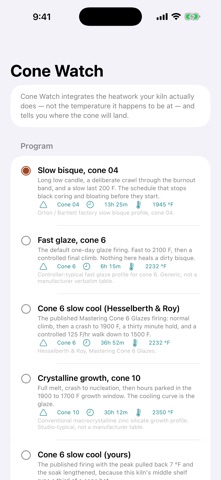
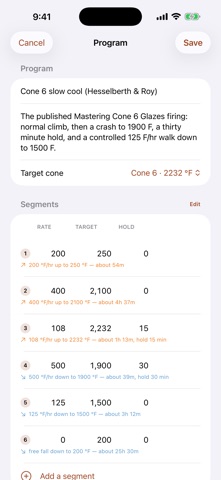
Version 2.0 turns on one small act you repeat through a firing: thumbing in whatever the pyrometer is showing, an hour or so at a time. You write the schedule the way a controller takes it, in ramp and target and hold, or start from one of four real programs, among them the long slow bisque to 04 and the Hesselberth and Roy cone 6 slow cool. Then you press Start alongside the kiln. Every reading you give it does two jobs. It re-derives, by least squares, the climb your kiln is honestly managing rather than the one you programmed. And it feeds an integral of heatwork across the curve you have actually recorded, with the temperature sensitivity fitted from the three published rate and temperature pairs Orton lists for each of thirty-four self-supporting cones. What you watch through the night is a fractional cone accruing, and two projections that disagree openly whenever the kiln is behind its schedule. Eleven bands name themselves as you cross them and say what is happening to the ware at each. Accrual carries on the whole way down the cool, where ten minutes of soak can be worth half a cone. Your position in the firing is re-derived from timestamps, so a cold launch six hours in lands where the running app would have been. When the lid finally comes up you photograph the witness pack, and the cones are found in the picture and handed to you as protractors to correct, so the bend angle itself is what gets read. The distance from the projection is bounded, weighted towards recent work, and stored against that kiln and that shelf. It is quietly folded into the next firing's number, which was the point of rebuilding this: that it should be less wrong about your kiln every time you fire it.
Price & rating history · US
Reconstructed from the listing changes AppTracker has observed in this storefront. A field is charted once it has changed more than once, and each line starts at the value it moved from.
Price · 2.99 USD now · 3 changes on record
In-app purchases · US
No in-app purchases.
Screenshots


About
Kilntrace is a private ceramic test lab that keeps the path from recipe to fired result intact. Build test-tile matrices across clay, glaze, thickness, and firing variables. Scale your own recipe percentages into a batch, preserve ingredient lot and application notes, attach each tile to a firing record, compare observed color and surface, and export local lab cards. KEY FEATURES - Test-tile matrix and code system - User-entered glaze recipes and batch scaling - Clay, application, kiln, and firing lineage - Result comparison and repeatability checkpoints - Searchable 90-plate offline ceramic guide - Local PDF lab brief - No account, ads, analytics, tracking, subscription, or network requirement Kilntrace is a recordkeeping tool, not chemistry or kiln advice. Follow current authoritative material and equipment instructions.
What's new · 2.0
Version 2.0 turns on one small act you repeat through a firing: thumbing in whatever the pyrometer is showing, an hour or so at a time. You write the schedule the way a controller takes it, in ramp and target and hold, or start from one of four real programs, among them the long slow bisque to 04 and the Hesselberth and Roy cone 6 slow cool. Then you press Start alongside the kiln. Every reading you give it does two jobs. It re-derives, by least squares, the climb your kiln is honestly managing rather than the one you programmed. And it feeds an integral of heatwork across the curve you have actually recorded, with the temperature sensitivity fitted from the three published rate and temperature pairs Orton lists for each of thirty-four self-supporting cones. What you watch through the night is a fractional cone accruing, and two projections that disagree openly whenever the kiln is behind its schedule. Eleven bands name themselves as you cross them and say what is happening to the ware at each. Accrual carries on the whole way down the cool, where ten minutes of soak can be worth half a cone. Your position in the firing is re-derived from timestamps, so a cold launch six hours in lands where the running app would have been. When the lid finally comes up you photograph the witness pack, and the cones are found in the picture and handed to you as protractors to correct, so the bend angle itself is what gets read. The distance from the projection is bounded, weighted towards recent work, and stored against that kiln and that shelf. It is quietly folded into the next firing's number, which was the point of rebuilding this: that it should be less wrong about your kiln every time you fire it.
Details