

Skivekeep: Leather Studio
Robert Corbin · Lifestyle
Independent analytics for this App Store listing. AppTracker is not affiliated with Robert Corbin.
Chart standing · US
What changed · US
Listing changes AppTracker has observed for this app in this storefront — new versions, price moves, rating shifts, and store copy.
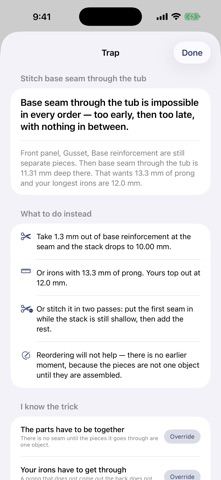
The hardest thing to fix in a bag is reach. Which faces a join is about to bury, and which operations quietly run out of chances altogether, was the one question the old Skivekeep could not answer, and it is the question 2.0 was built around. You draw the seam end-on as a live cross-section and close it join by join, and each face that goes out of reach goes grey at the exact step that did it. What that buys at the bench is an argument in physical terms. Each operation now carries what makes it possible at all: a burnisher bearing on both sides of a free veg tan edge, irons deep enough for the live stack, a post suited to the hardware. Those needs are measured against the tooling on your own sheet, so a build can be workable on your bench and hopeless on someone else's. Anything with a last call is marked amber on the rail at the close that ends it, and where an operation has no possible position in any order, the verdict line counts it, the row below names it, and the inspector gives the change that would clear it: a stitch line moved inboard, an edge turned rather than left raw, a longer post. What it costs is worth knowing first. Version 1.0 was a different app: hide and offcut stock with thickness, temper and a bin address, cut plans, thread and hardware costings, checkpoints, a bench brief you could write out as a PDF, and a shelf of bundled reference cards. None of that is in 2.0, and nothing you entered into it comes across, so copy out anything you still want before you install. And nothing here prints or sends: a closing order is read at the section that produced it, with the glue open and one clean hand.
Price & rating history · US
Reconstructed from the listing changes AppTracker has observed in this storefront. A field is charted once it has changed more than once, and each line starts at the value it moved from.
Price · 2.99 USD now · 3 changes on record
Screenshots



About
Skivekeep is a private leather studio for makers who want usable stock, project demand, and true build cost in one place. Catalog hides and offcuts by tannage, temper, thickness, color, dimensions, cost, and storage address. Build a project bill of materials, compare usable area with a user-set waste reserve, estimate stitch thread, track hardware, and export a local PDF bench brief. KEY FEATURES - Hide, panel, offcut, and hardware inventory - Visual cut-consumption map - Area, reserve, stitch, and project-cost math - Project allocation and bench checkpoints - Searchable 90-plate offline leather guide - Local PDF build brief - No account, ads, analytics, tracking, subscription, or network requirement All results depend on your measurements. Confirm patterns, grain, defects, material behavior, and safe tool use before cutting valuable stock.
What's new · 2.0
The hardest thing to fix in a bag is reach. Which faces a join is about to bury, and which operations quietly run out of chances altogether, was the one question the old Skivekeep could not answer, and it is the question 2.0 was built around. You draw the seam end-on as a live cross-section and close it join by join, and each face that goes out of reach goes grey at the exact step that did it. What that buys at the bench is an argument in physical terms. Each operation now carries what makes it possible at all: a burnisher bearing on both sides of a free veg tan edge, irons deep enough for the live stack, a post suited to the hardware. Those needs are measured against the tooling on your own sheet, so a build can be workable on your bench and hopeless on someone else's. Anything with a last call is marked amber on the rail at the close that ends it, and where an operation has no possible position in any order, the verdict line counts it, the row below names it, and the inspector gives the change that would clear it: a stitch line moved inboard, an edge turned rather than left raw, a longer post. What it costs is worth knowing first. Version 1.0 was a different app: hide and offcut stock with thickness, temper and a bin address, cut plans, thread and hardware costings, checkpoints, a bench brief you could write out as a PDF, and a shelf of bundled reference cards. None of that is in 2.0, and nothing you entered into it comes across, so copy out anything you still want before you install. And nothing here prints or sends: a closing order is read at the section that produced it, with the glue open and one clean hand.
Details