

Cosmic Specks
Kaolin Fire · Education
Independent analytics for this App Store listing. AppTracker is not affiliated with Kaolin Fire.
Chart standing · US
Ratings breakdown · US
The star breakdown behind this app's rating in this storefront.
Screenshots




About
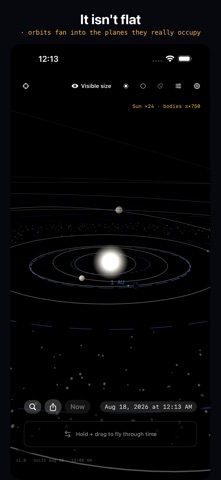
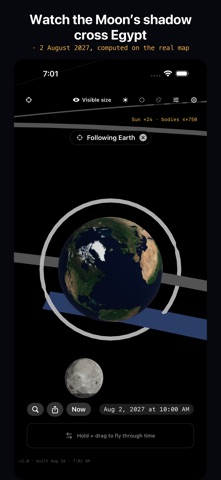
Space is almost all empty. That turns out to be the beautiful part. Every picture of the solar system you've ever seen tells you small white lies. The planets are swollen so you can see them. The orbits are squashed flat and drawn as tidy circles. Everything is crowded together so it fits on the page. Cosmic Specks is the same solar system with the lies switched off, one at a time, so you can build an intuition for what was actually removed. IT OPENS WITH THE ARGUMENT. A ninety-second tour names the five lies and switches each one off, live: the sizes, the flatness, the circles, the stillness, the diagram eclipses. IT ISN'T FLAT. Turn on inclinations and the orbits fan out into the tilted planes they really occupy — Pluto's 17°, Mercury's 7°, the quiet disagreement the flat diagram hides. EVERYTHING SPINS. Each body turns on its own axis, at its own rate, at its own lean: Venus backwards, Uranus on its side, the Moon locked forever facing home. HALLEY'S COMET TAKES AN EPIC RUN. Seventy-six years, out past Neptune and back, on an orbit so long and lopsided it barely belongs on the same diagram. SWIM THROUGH TIME. Watch conjunctions close, planets loop backwards through retrograde, Saturn's rings turn edge-on and all but vanish, Venus cross the face of the Sun. JUMP TO A PRECISE ECLIPSE and see how tight the Moon's shadow really is — a couple of hundred kilometres of darkness, brushing over the Earth for a few minutes, landing on the real map where it really lands. On 2 August 2027 it crosses southern Spain and Egypt; jump there and watch. And when you want the honest picture of size: one tap drops everything to true scale, where the planets become the specks they are, and the emptiness is the whole photograph. HONEST BY CONSTRUCTION. Every solar-system app draws a picture; this one also shows you the picture's error. Bodies are enlarged so you can see them at all — and the exact factors are printed on screen the entire time you're looking (Sun ×24, bodies ≤×750). Positions are computed on your device from orbital elements, so the app also tells you when it stops being trustworthy: good near today, approximate centuries out, illustrative in the deep millennia. Even the maps admit their gaps: Miranda is half blank because humanity has only ever seen half of it. WHAT IT DOESN'T DO. No account. No ads. No subscription. No analytics — App Privacy is "Data Not Collected". Nothing leaves your phone. Free, with one optional purchase that opens 10,000 years in each direction.
What's new · 1.0.1
A seventh lie, and the purchase that was missing. • Lie 6 of 7: the Moon and Jupiter, all but touching. A sky chart draws them side by side. Swing the camera and watch two things two and a half thousand times apart come apart. • The Moon's facts sheet now shows its next close pass by a bright planet, with a Jump to the moment. • Earth's night side has its city lights. • iPad turns sideways. • The "20,000 Years" unlock is now available — it did not ship with 1.0. Fixes: the tour no longer trips the unlock sheet mid-way on the free tier; the scale readout tells the truth in True size at every scale; the build watermark is gone from the corner; the build number lives at the top of Settings instead.
Details