

Conjugaid - Japanese Verbs
Timothy Krechel · Education
Independent analytics for this App Store listing. AppTracker is not affiliated with Timothy Krechel.
Chart standing · US
What changed · US
Listing changes AppTracker has observed for this app in this storefront — new versions, price moves, rating shifts, and store copy.
New in Settings: Sources and licences names where the verb data comes from (OpenJLPT and JMdict), the typeface and the analytics component, each with a link to its licence. Also new there: an optional, anonymous feedback form. From this version on, the app sends anonymous usage statistics, so it becomes visible which levels and forms people practise and where the app falls short. Your progress stays on your device; the privacy policy lists exactly what is sent.
In-app purchases · US
What this app sells inside itself, grouped by kind and priced for this storefront.
Screenshots

About
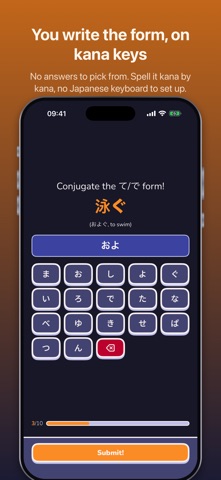
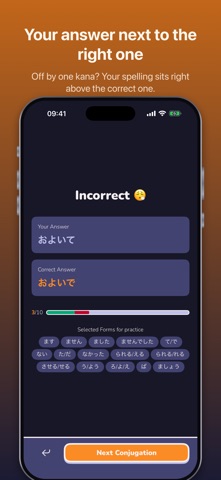
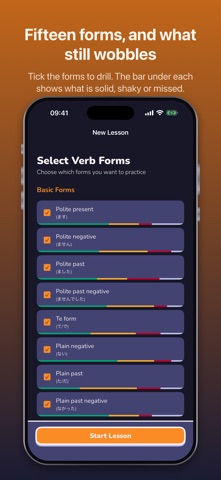
Conjugaid drills Japanese verb conjugation. A verb and a form appear on screen, say the polite past, the te form or the causative, and you write it out on a hiragana keyboard built into the app. No Japanese keyboard needed, and nothing to set up. 1,442 verbs from JLPT N5 to N1, fifteen forms each, 21,630 forms in all. No account and no sign-up. Practice works offline, on a plane too. WHAT YOU PRACTISE Fifteen forms Eight basic ones: polite present, polite negative, polite past, polite past negative, the te form, plain negative, plain past and plain past negative. Seven advanced ones: potential, passive, causative, volitional, polite volitional, imperative and conditional. Five JLPT levels 112 verbs at N5, 204 at N4, 233 at N3, 383 at N2 and 510 at N1. Practise one level on its own or combine several. All three verb classes 905 godan, 468 ichidan and 69 irregular verbs. Switch a class off and the lesson leaves it out, so you can spend a round on godan endings alone. You build the lesson Pick the forms you want, the JLPT levels, the verb classes and how many verbs a lesson runs. Nothing is chosen for you. HOW YOU ANSWER You type the form yourself on the hiragana keyboard in the app: no multiple choice, and no switching input methods. Every answer shows what you wrote next to the correct form, so a wrong okurigana is visible instead of just wrong. WHAT STICKS Every verb and every form carries its own state: new, missed, learning, or solid after three correct answers in a row. The lesson setup shows a bar under each of the fifteen forms, so you can see which ones are still shaky before you pick them, instead of guessing. THE FORMS ARE GENERATED, NOT TYPED Every one of the 21,630 forms is produced from the conjugation rules at build time rather than kept in a hand-written table. The two genuine lexical exceptions, ある becoming ない and the imperative of くれる, are written out as exceptions. A table that size, maintained by hand, drifts; this one cannot. NINE LANGUAGES The interface speaks English, German, Korean, Vietnamese, Chinese (Simplified and Traditional), Indonesian, Thai and Malay. The meanings of 137 core verbs from N5 and N4 are written in all nine; the other verbs show an English dictionary gloss. WHAT IS FREE JLPT N5 with 112 verbs and the eight basic forms, with no time limit, no ads and no account. One purchase adds the 1,330 verbs from N4 to N1 and the seven advanced forms. One time, not a subscription, and Family Sharing is included. If you bought Conjugaid before version 2.0, you already have everything. Nothing to buy again. PRIVACY No account, no ads. Your progress stays on your device. To see how the app is used, Conjugaid sends anonymous usage statistics to PostHog in the EU: app installs and launches, practice rounds started, the purchase screen and purchases, and feedback if you choose to send it. Nothing that identifies you, no tracking across apps, no session recording. The details are in the privacy policy linked on this page.
What's new · 2.0.3
New in Settings: Sources and licences names where the verb data comes from (OpenJLPT and JMdict), the typeface and the analytics component, each with a link to its licence. Also new there: an optional, anonymous feedback form. From this version on, the app sends anonymous usage statistics, so it becomes visible which levels and forms people practise and where the app falls short. Your progress stays on your device; the privacy policy lists exactly what is sent.
Details