

iVCS3
Alessandro Petrolati · Music
Independent analytics for this App Store listing. AppTracker is not affiliated with Alessandro Petrolati.
Chart standing · US
What changed · US
Listing changes AppTracker has observed for this app in this storefront — new versions, price moves, rating shifts, and store copy.
Updated for iOS/iPadOS 27
Price & rating history · US
Reconstructed from the listing changes AppTracker has observed in this storefront. A field is charted once it has changed more than once, and each line starts at the value it moved from.
Price · 19.99 USD now · 2 changes on record
Ratings breakdown · US
The star breakdown behind this app's rating in this storefront.
In-app purchases · US
What this app sells inside itself, grouped by kind and priced for this storefront.
Screenshots
Keywords this app targets
Search terms AppTracker associates with this app — estimates, not search volume. ❝ = in the app's title; a highlighted number is its current position for that term.
Similar apps
Competitors and close alternatives, as estimated by AppTracker.
 VB3m
Genuine Soundware
2 shared topics
VB3m
Genuine Soundware
2 shared topics
 Retromulator
DiscoDSP LLC
3 shared topics
Retromulator
DiscoDSP LLC
3 shared topics
 ShockWave - Synth Module
Kai Aras
2 shared topics
ShockWave - Synth Module
Kai Aras
2 shared topics
 VTines Live
ACOUSTICSAMPLES
2 shared topics
VTines Live
ACOUSTICSAMPLES
2 shared topics
 CV Mod
Steven Connelly
1 shared topic
CV Mod
Steven Connelly
1 shared topic
 Voice Synth
Qneo
1 shared topic
Voice Synth
Qneo
1 shared topic
 EGSY01 Analog Synth
andrea angelini
1 shared topic
EGSY01 Analog Synth
andrea angelini
1 shared topic
 ANALOGySTR
Rob Jackson
2 shared topics
ANALOGySTR
Rob Jackson
2 shared topics
About
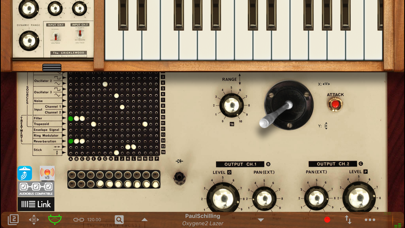
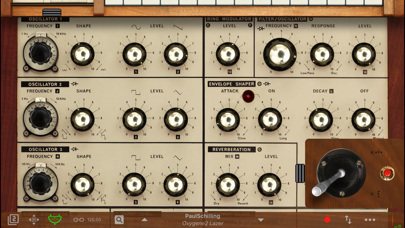
iVCS3 Official EMS VCS3 emulator The VCS3 was created in 1969 by Peter Zinovieff's EMS company. The electronics were largely designed by David Cockerell and the machine's distinctive visual appearance was the work of electronic composer Tristram Cary. The VCS3 was more or less the first portable commercially available synthesizer—portable in the sense that the VCS 3 was housed entirely in a small, wooden case. The VCS3 was quite popular among progressive rock bands and was used on recordings by The Alan Parsons Project, Jean Michel Jarre, Hawkwind, Brian Eno (with Roxy Music), King Crimson, The Who, Gong, and Pink Floyd, among many others. Well-known examples of its use are on The Who track "Won't Get Fooled Again" (as an external sound processor, in this case with Pete Townshend running the signal of a Lowrey Organ through the VCS3's filter and low frequency oscillators) on Who's Next. Pink Floyd's "On the Run" (from The Dark Side of the Moon) made use of its oscillators, filter and noise generator, as well as the sequencer. Their song Welcome to the Machine also used the VCS3. The bassy throb at the beginning of the recording formed the foundation of the song, with the other parts being recorded in response. The VCS3 was also a staple at the BBC’s Radiophonic Workshop, and was a regular (and most frightening) sound generator for the Dr Who TV series. Many fo the monsters and atmoshere;s created for the show came directly from the VCS3. Description The VCS3 has three oscillators (in reality, the first 2 oscillators are normal oscillators and the 3rd an LFO or Low Frequency Oscillator), a noise generator, two input amplifiers, a ring modulator, a 18dB/octave (pre-1974) or 24dB/octave (after 1974) voltage controlled low pass filter (VCF), a trapezoid envelope generator, joy-stick controller, voltage controlled spring reverb unit and 2 stereo output amplifiers. Unlike most modular synthesizer systems which use cables to link components together, the VCS3 uses a distinctive patch board matrix into which pins are inserted in order to connect its components together. Keyboards controller DK1 keyboard controller Although the VCS3 is often used for generating sound effects due to lack of built-in keyboard, there were external keyboard controllers for melodic play. The DK1 in 1969 was an early velocity sensitive monophonic keyboard for VCS3 with an extra VCO and VCA. Later it was extended for duophonic play, as DK2, in 1972. Also in 1972, Synthi AKS was released, and its digital sequencer with a touch-sensitive flat keyboard, KS sequencer, and its mechanical keyboard version, DKS, were also released. (See: en.wikipedia.org/wiki/VCS3)
What's new · 3.6.5
Updated for iOS/iPadOS 27
Details