
Chart standing · US
What changed · US
Listing changes AppTracker has observed for this app in this storefront — new versions, price moves, rating shifts, and store copy.
The frozen readout. A freeze now always begins with the separators lit, and they blink from the moment you press FREEZE rather than from wherever the cycle happened to be. Through the dark half of each pulse they are drawn in a faint gray instead of disappearing, so a frozen readout still reads as timecode between pulses. Landscape layout. The transport column is wider, so FREEZE, RESUME and a captured COPY value all sit at full size on a phone held sideways. The width comes out of the digits, which had it to spare. The OUT sheet now says what a chaser does while a FREEZE stands, and Settings explains why iOS reports microphone access while only OUT is sending: the app opens the audio input and output together, so timecode can arrive and leave at the same time. No audio is saved, and none of it leaves the device. In the log export, the generator's line reports its output level in dB with the device volume beside it, and a reader that cannot start records one line per stall instead of one per retry.
Screenshots


About
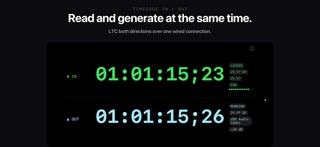
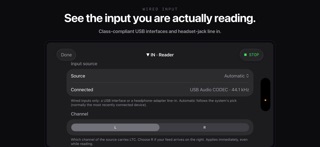
4:20 is an SMPTE LTC timecode reader and generator for iPhone and iPad. It reads timecode from a wired audio input and shows lock, frame rate, drop frame, measured rate, direction, and level. It can generate LTC at the same time, over the same connection. The reader is made for troubleshooting. When a rig will not chase, plug into the line and check the code where you stand: the rate as measured against what the source claims, drop frame or not, which direction it is running, and how hot the line is. Mislabeled rates, code that should have stopped, and low or clipping levels all show up in the first few seconds. Between cues, it works as a confidence monitor on any line you need to trust. The screen does not sleep while a mode is running, and timecode keeps going when you switch to another app. Checking a message does not stop the code. READER • Lock state and a full readout: frame rate with drop frame flag, measured rate, direction, level • Runs continuously and keeps reading through route changes and interruptions • Keeps reading in the background while you use another app • If iOS takes the audio session away, the readout dims and says so instead of holding stale numbers GENERATOR • 23.976, 24, 25, 29.97 drop frame, and 30 fps • Start from any timecode, or generate time of day • Output level control, with left, right, or both channel routing • Anchored to the system clock, so long runs hold their time • Keeps generating in the background while you use another app • Runs alongside the reader for loop-through checks • Warns before sending LTC to a speaker, Bluetooth, or AirPlay, and requires a press-and-hold to override REQUIREMENTS A wired audio connection: a class-compliant USB audio interface, or a headset-jack adapter with a line input. There is no microphone mode. This version reads and generates LTC only; MIDI timecode is not supported. PRIVACY No account, no analytics, and no network connection. Nothing leaves the device. Made for production sound, playback and show control, video engineering, DIT carts, and broadcast maintenance.
What's new · 1.1.1
The frozen readout. A freeze now always begins with the separators lit, and they blink from the moment you press FREEZE rather than from wherever the cycle happened to be. Through the dark half of each pulse they are drawn in a faint gray instead of disappearing, so a frozen readout still reads as timecode between pulses. Landscape layout. The transport column is wider, so FREEZE, RESUME and a captured COPY value all sit at full size on a phone held sideways. The width comes out of the digits, which had it to spare. The OUT sheet now says what a chaser does while a FREEZE stands, and Settings explains why iOS reports microphone access while only OUT is sending: the app opens the audio input and output together, so timecode can arrive and leave at the same time. No audio is saved, and none of it leaves the device. In the log export, the generator's line reports its output level in dB with the device volume beside it, and a reader that cannot start records one line per stall instead of one per retry.
Details