

Learn Ugaritic Cuneiform!
Ethan Hartzell · Education
Independent analytics for this App Store listing. AppTracker is not affiliated with Ethan Hartzell.
Chart standing · US
In-app purchases · US
No in-app purchases.
Screenshots
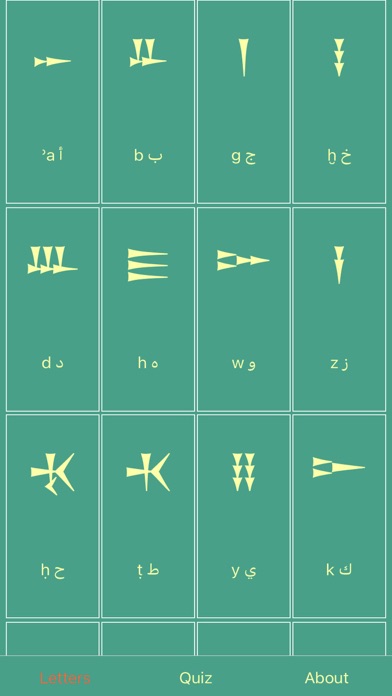


About
The Ugaritic cuneiform abjad developed from the more complex Sumerian cuneiform. The Ugaritic language is an extinct Northwest Semitic language, making its closest living relatives Hebrew and Neo-Aramaic varieties such as Syriac and Mandaic. Each cuneiform sign is displayed with its typical transliteration and Arabic equivalent. In the quiz section, you can specify if you want to quiz yourself against the transliteration or IPA, Syriac, Hebrew, Arabic, or Phoeneician equivalents. The Ugaritic signs are listed in the Northern order, similar to what is used for Hebrew. There is also a southern alphabetical order more similar to that used for South Arabian languages. Ugaritic was first discovered on clay in Ugarit, which is today called Ras Al Shamra, Syria. It has 30 letters, and one punctuation mark (a word divider). It was written starting sometime around 1400 BCE for a few hundred years. The phonological value of the letter "s2" is still debated. Cuneiform has also been used to write Sumerian, Akkadian (another Semitic language), Elamite, Hittite, Hurrian, and even Old Persian.
Details